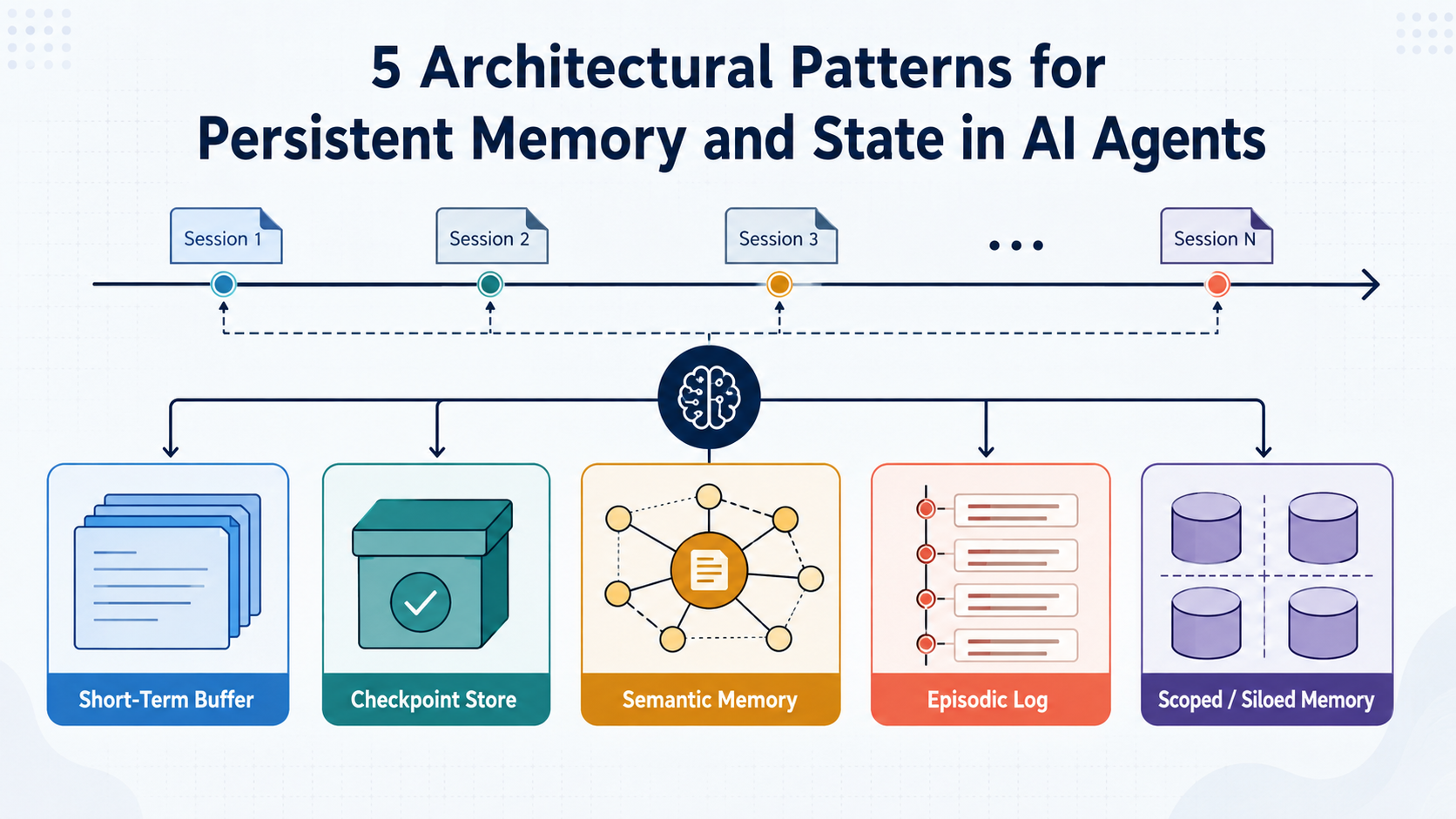
Here’s a truth the hype cycle doesn’t want you to hear: the biggest problem with AI agents isn’t the model’s IQ. It’s that they’re amnesiacs. LLMs are stateless by design. Every call is a blank slate. The early hack was to just cram the entire chat history into the context window, but that strategy falls apart in days, not months. Latency chokes, costs spike, and the model gets confused by old, stale facts buried in the transcript.
The real fix is treating memory and state as first-class architectural problems, not an afterthought you slap on before shipping. The key is understanding the difference. State is the agent’s whiteboard—the snapshot of what it’s doing right now, like which step it’s on or the result of the last tool call. Memory is what carries information across boundaries, into the next session or to a different agent entirely. They feed each other: memory loads the initial state, the agent updates that state as it works, and then it writes key pieces back to memory for next time. When these two get conflated is precisely when production systems break. A corrupted state means the agent derails mid-task. Bad memory means it never learns and treats every interaction like it just met you.
To fix this, developers are converging on a handful of practical design patterns. The first, a working buffer, is non-negotiable for everyone. Instead of letting a message list grow until it bursts, you use a sliding window that periodically compresses old turns into a dense summary, dumping the raw tool outputs. The catch? That summarization step rewrites the prompt prefix, which invalidates the cache and can cause a nasty latency spike on the next call. It’s a real trade-off. Then there’s execution checkpointing, which is non-negotiable for anything that runs longer than a few minutes. When an agent crashes or waits for human approval, its entire workflow state—variables, history, position in the graph—needs to be saved to a durable database like PostgreSQL so it can resume without redoing work. The gotcha here is idempotency. If a step partially executed before the crash, it might run twice, so you better not be sending that email twice by accident.
The longer-term memory patterns are where things get interesting, requiring a deliberate strategy to move beyond just the current conversation. These aren’t just technical tricks; they’re the difference between a cool demo that falls apart in production and an agent that actually gets more useful over time.