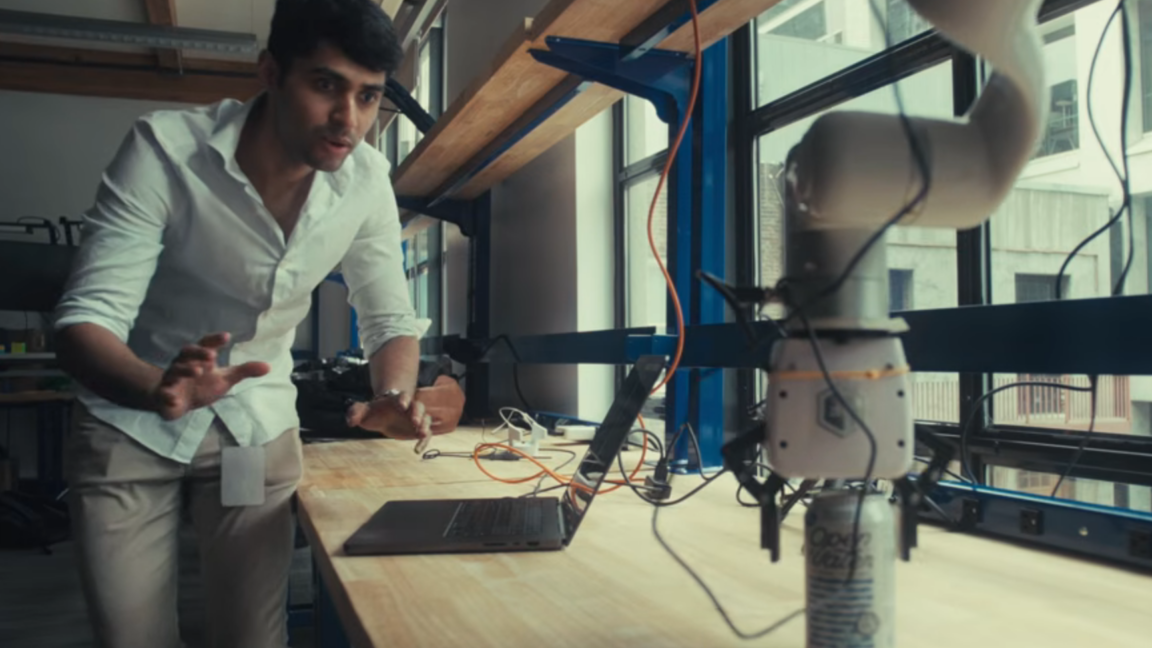
Anthropic wants AI agents to get their hands on actual hardware, not just pixels and text. The company just introduced the Model Hardware Standard, a set of standardized drivers designed to let AI systems interface with arbitrary physical devices — microscopes, lasers, cameras, the whole bench. It’s being positioned as a research preview aimed squarely at scientists who currently burn weeks or months writing custom glue code to get disparate lab instruments talking. Anthropic claims MHS can compress that setup time to hours or minutes by providing a common interface and data-sharing format across networked devices, no bespoke translator programs required.
The origin story is refreshingly specific. Anthropic technical staffer Alek Kemeny watched neuroscientist Arco Bast at HHMI’s Janelia Research Campus orchestrate a memory-formation experiment involving rotating laser beams, microscopes, and cameras through a unified interface. Kemeny’s reaction, captured in the announcement video: “This idea could be used to have AI run any science experiment in the world.” That’s the pitch in one sentence — and it’s not an unreasonable leap given how much of modern experimental science is already software-mediated.
MHS doesn’t require AI at all. Researchers can drive connected devices directly through command-line prompts or API code files. But pair MHS with Anthropic’s existing Model Context Protocol and the picture changes: scientists can issue natural-language instructions, while models “reason through each step in an experiment, update parameters in real time, and, in some cases, recover from hardware errors without intervention.” That last capability — autonomous error recovery — is where the value likely concentrates. Anyone who’s debugged a misbehaving lab rig at 2 a.m. knows hardware failures eat more time than successful runs.
The move extends Anthropic’s agent strategy beyond the screen and into the physical world, a direction competitors have approached through robotics rather than instrumentation standards. If MHS gains traction in academic labs first — where the pain of custom integration is most acute and budgets are tightest — it could become a de facto standard before commercial vendors even notice. That’s how USB and MIDI won, and Anthropic seems to understand the playbook. The open question is whether instrument manufacturers will adopt the standard natively or force labs to keep maintaining adapters — which would quietly defeat the entire purpose.