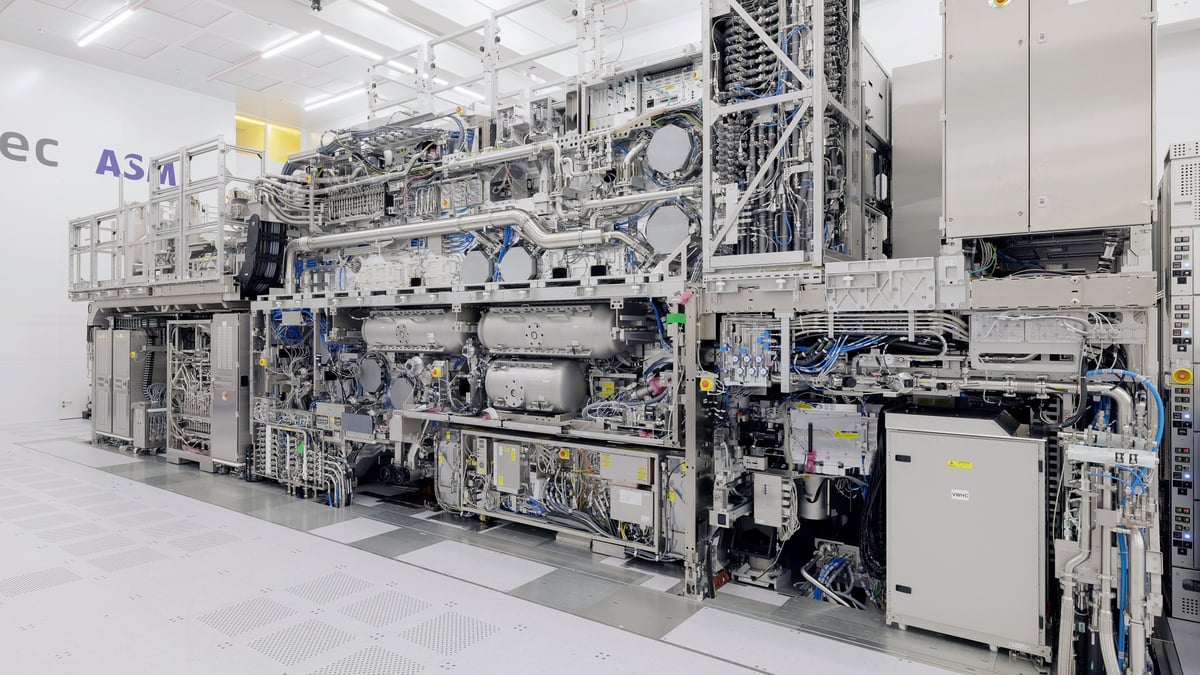
The global semiconductor supply chain just got a lot more predictable, at least for the West’s top tier. ASML has locked in commitments from its three biggest customers—Intel, Samsung, and TSMC—to adopt its next-generation High-NA EUV lithography systems. Intel is already running the machines, but the real news is the timeline for the others. Samsung plans to start high-volume manufacturing with the tech in 2028, while TSMC follows in 2030. Each of these behemoths costs up to $400 million, representing a massive capital bet on the future of AI chip density.
This isn’t just about buying expensive hardware. The deal hinges on a coordinated shift from six-inch to twelve-inch photomasks. Think of these masks as stencils for printing circuits. By doubling their size, manufacturers can image larger areas in a single exposure. ASML technology chief Marco Pieters calls this a “huge opportunity,” noting it could boost throughput by 40 percent. For years, TSMC resisted this change, arguing the productivity gains didn’t justify the cost. Their reversal signals that the complexity of stacking chips vertically has finally hit a wall. A test line for these larger masks arrives in 2031, with production slated for 2033.
While the West consolidates around ASML’s monopoly, China is scrambling for an exit ramp. Huawei is orchestrating a push to strip foreign tech from its supply chain, focusing not on cutting-edge EUV but on mastering Deep Ultraviolet (DUV) lithography. Through entities like Yuliangsheng, Huawei aims to produce domestic DUV machines, targeting twelve units by year-end. It’s a stopgap measure. DUV requires complex multi-patterning to achieve what EUV does in one step, driving up costs and lowering yields. Yet, with Bernstein analyst Lin Qingyuan noting Huawei’s role as a central orchestrator, Beijing is betting that volume and coordination can overcome technical deficits.
The divergence is stark. The US and its allies are doubling down on the most advanced tools available, securing their lead in AI accelerator production. China is forced to innovate around sanctions, relying on mature tech and secondary markets for components like Zeiss lenses. This two-track reality means the gap in leading-edge logic chips will likely widen, even as China achieves self-sufficiency in legacy nodes. The question isn’t if China can catch up on EUV soon—it’s whether they can make DUV profitable enough to sustain their AI ambitions without it.


