Most AI agents handle single-turn queries fine, but fall apart when they need to query your database, remember earlier context, or explain their reasoning. LangGraph tackles this by modeling an agent as a stateful graph with three core primitives: state, nodes, and edges.
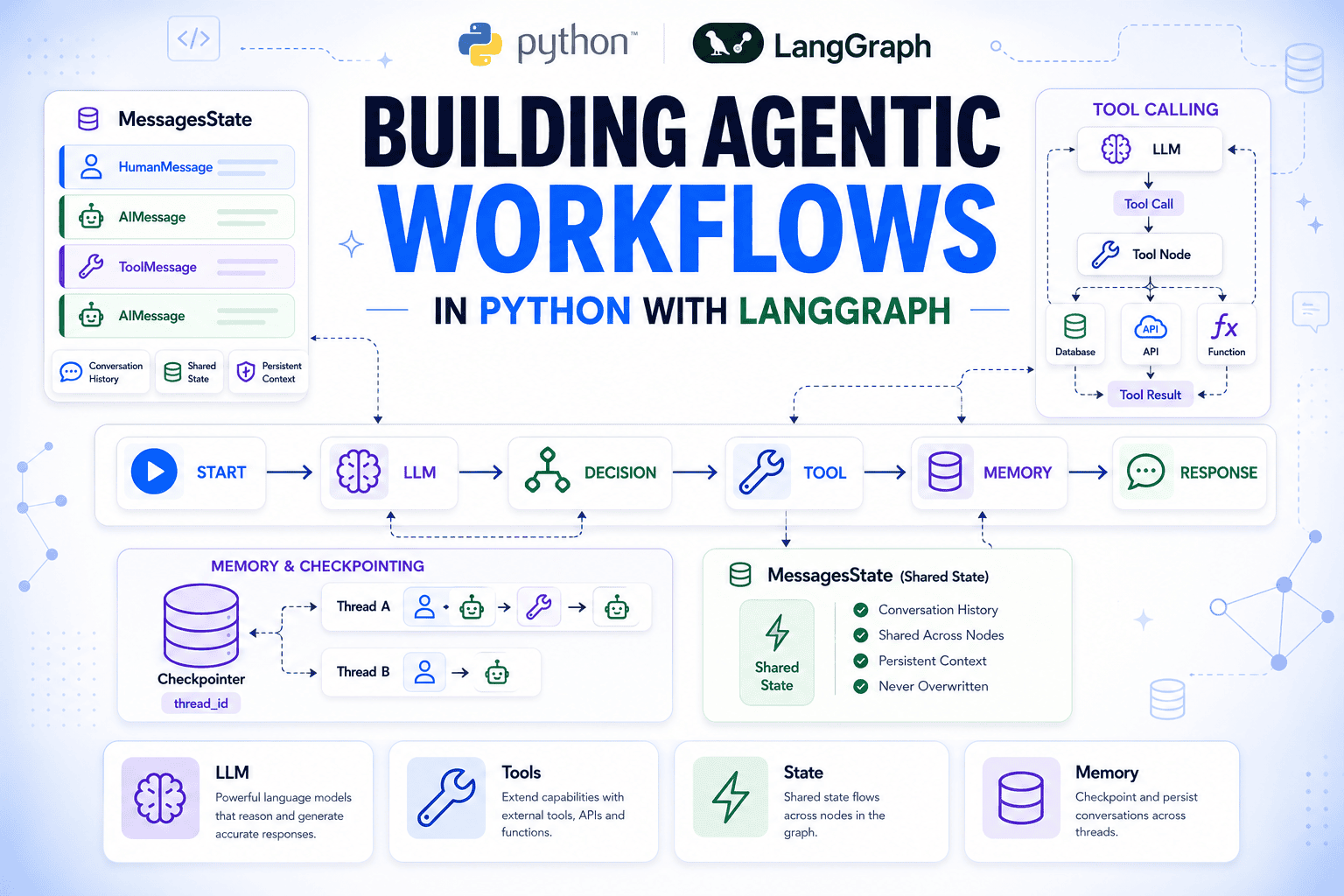
State is a shared TypedDict that carries the entire conversation history through every step. Nothing passes between nodes any other way. Fields you don’t update stay untouched, and for lists like message logs, you annotate them with a reducer function so new entries append instead of replacing. LangGraph ships with MessagesState, a pre-built state type that uses the add_messages reducer to handle deduplication and ordering automatically. You don’t stitch together history manually.
Nodes are plain Python functions that read state and return a dictionary of what they want to change. Edges define what runs next — add_edge for fixed sequences, add_conditional_edges to route based on a function’s output. Every graph needs START as its entry point and at least one path to END. The model runs inside a node, so every reasoning step, tool call, and response becomes part of the graph’s visible state.
What makes this production-ready is the checkpointer. Adding one persists conversation history across separate invocations, so an agent remembers context from earlier sessions without custom plumbing. This means you get a tool-using agent with persistent memory built on inspectable, traceable execution flow — no black boxes, no lost context, no reinventing the wheel for each use case.