ByteDance Seed and Tsinghua AIR just published a system that tackles one of the most stubborn gaps in AI-assisted coding: models can write correct CUDA, but they write slow CUDA. Their fix, CUDA Agent, puts a language model inside an actual GPU development environment — profiling tools, correctness checks, a permission-locked sandbox — and trains it with reinforcement learning to optimize kernels until they beat torch.compile.
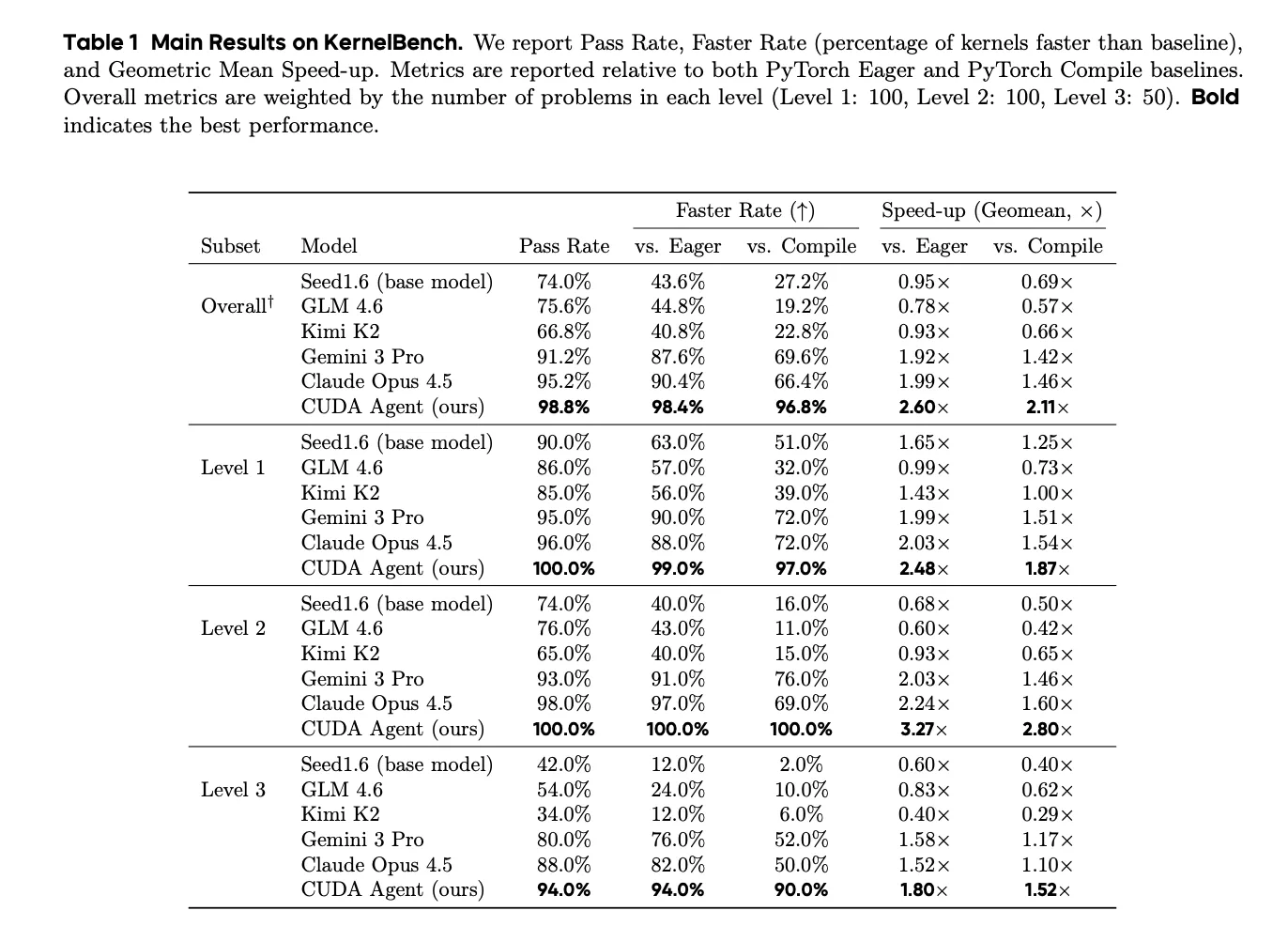
The base model, Seed1.6, passes 74% of KernelBench tasks but only outruns torch.compile on 27.2% of them, landing at a 0.69× geometric-mean speedup. That means its kernels are, on average, worse than what the compiler produces by itself. After 150 PPO steps at a 131,072-token context, CUDA Agent flips those numbers: 98.8% pass rate, 96.8% faster-than-compile rate, and a 2.11× geomean speedup across all 250 tasks. On the hardest Level-3 split, it’s roughly 40 points ahead of Claude Opus 4.5 and Gemini 3 Pro.
The training recipe matters more than the model. Ablations show removing the agent loop collapses the faster-than-compile rate from 96.8% to 14.1%. A raw speedup reward gets you only 60.4% — the discrete milestone reward (r ∈ {−1, 1, 2, 3}) adds 36.4 points. Reinforcement fine-tuning plus value pretraining is what keeps training stable across 150 steps instead of collapsing at step 17.
Here’s the catch for anyone hoping to download this: the weights are not public. Seed1.6 is a proprietary mixture-of-experts model with 23B active and 230B total parameters. The profiling sandbox alone needed 128 NVIDIA H20 GPUs. What is public — the CUDA-Agent-Ops-6K dataset, the SKILL.md spec, and the reward recipes — is enough for mid-size teams to adapt the approach on top of an open base model. The case studies hint at the ceiling: a diagonal matmul rewritten as row-wise scaling hits 73.31× over torch.compile. That’s the kind of gain that changes cost-per-token math for inference providers, and it’s why this paper will get read carefully even without the weights.