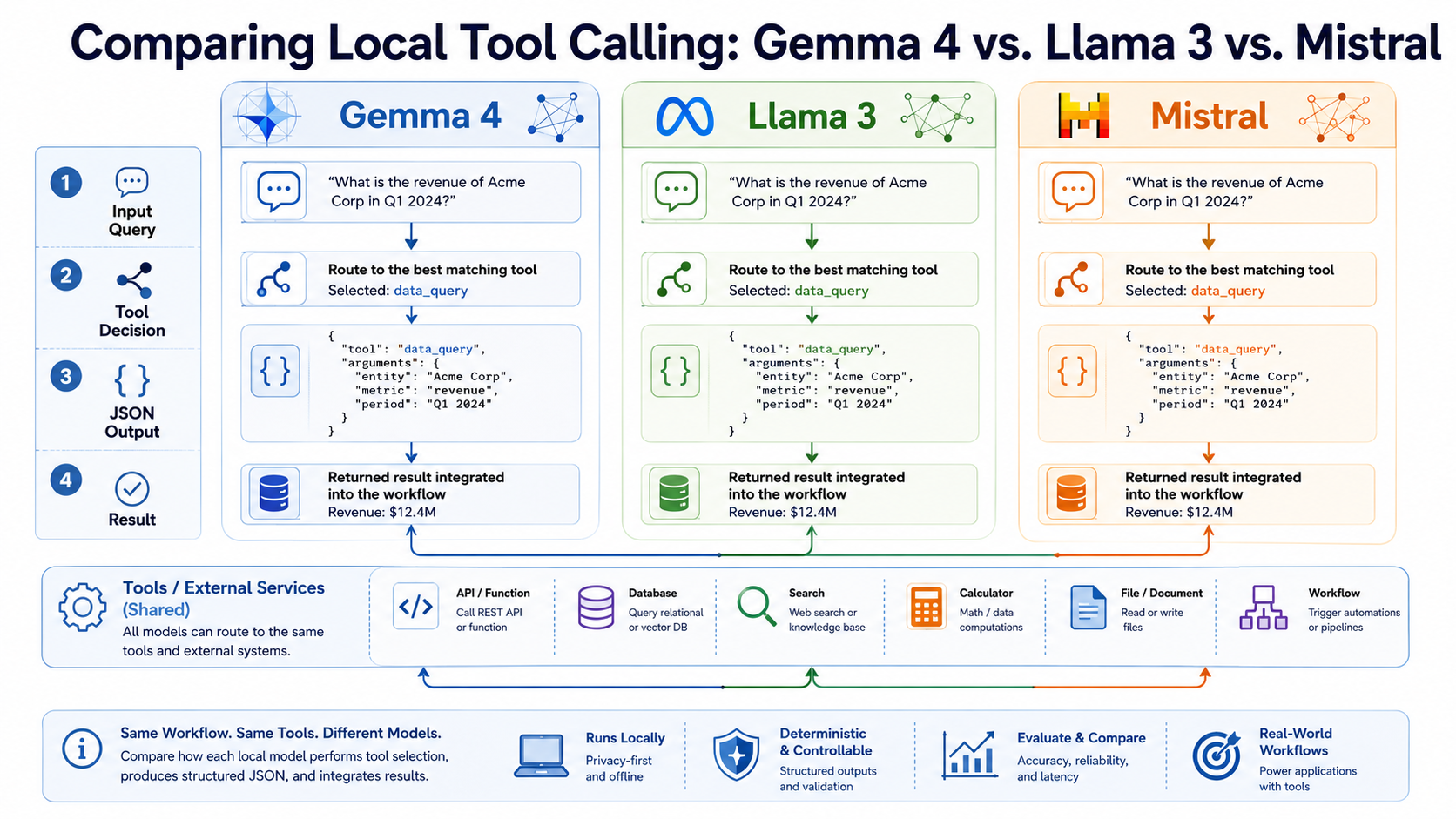
Tool calling is what separates a text generator from something that can actually do work. When a model runs locally, it has no internet, no database, no memory beyond its context window. Function calling fixes that by letting the model emit structured JSON that triggers an external API call or script execution. Three open-weight families now compete for this capability, and they’ve taken genuinely different paths.
Gemma 4, released April 2, 2026, ships with native function calling across its entire lineup, from the tiny E2B edge model up to the 31B server-class variant. That’s a meaningful shift from earlier Gemma generations, which required prompt engineering gymnastics to coax reliable tool use. The multimodal architecture — text, image, video, and audio inputs — means a Gemma model could theoretically call a function based on what it sees in an image, not just what it reads in text. The 256K context window on mid-sized variants gives agentic workflows room to breathe, and Apache 2.0 licensing removes most commercial friction.
Llama 3 took a versioned approach instead. The original 8B and 70B releases in 2024 had no native tool calling. It wasn’t until Llama 3.1 — and specifically the 405B flagship — that Meta baked in fine-tuning for structured JSON emission and function selection. The smaller 8B models still struggle with multi-tool scenarios, which tracks with what you’d expect: recognizing which of several functions to call requires a level of reasoning that 8 billion parameters doesn’t reliably deliver. The Community License is generous for most use cases, though the 700 million monthly active user cap and restrictions on training competing systems are worth reading carefully if you’re building at scale.
Mistral’s approach reflects the company’s efficiency-first philosophy, though the source article leaves some specifics vague. What’s clear across all three families is that native tool-calling support has become table stakes for local deployment — not a differentiator but a baseline requirement. The real question for developers is whether their chosen model can handle multi-step agentic workflows, where a single user request triggers a chain of tool calls with dependencies. That’s where the gap between marketing claims and real-world reliability tends to show up, especially on consumer hardware with 8B-class models.