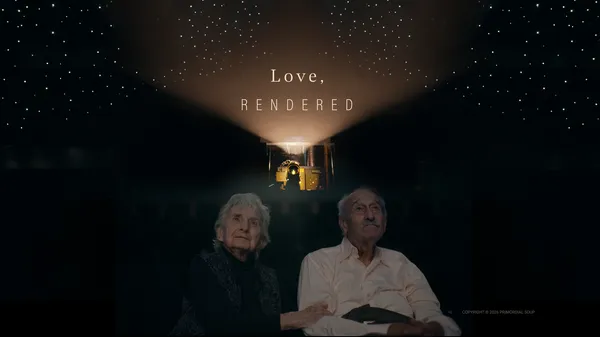
Memory is fragile, especially when cognitive decline erases the moments that define a life. “Love, Rendered,” a new documentary short directed by Academy Award nominee Liz Garbus, tackles this heartbreak head-on. The film follows Burt and Ethelle Shatz, married for over 70 years, as they navigate Burt’s fading memories. One specific day stood out: their first meeting at a student co-op in Cleveland. No photos existed. No video captured it. It lived only in their minds, slipping away with Burt’s health.
To rescue this lost moment, Garbus partnered with Google DeepMind and Darren Aronofsky’s creative venture, Primordial Soup. The technical lead, whose own grandfather suffered from memory loss, saw this as more than a visual effects challenge. It was a chance to test if AI could serve as a bridge for reminiscence therapy. This clinical practice uses sensory cues to spark connections, but it usually relies on existing artifacts. Here, the team had to build the artifact from scratch. Ethelle didn’t just watch; she co-created. She corrected the curve of a staircase and the shape of a shoe heel, ensuring the digital reconstruction matched her lived reality.
The workflow blended two distinct AI capabilities. First, generative models restored and colorized black-and-white photos of the couple’s youth, establishing a visual baseline. Second, performance capture models mapped Burt and Ethelle’s current micro-mannerisms onto their younger digital likenesses. The tilt of Burt’s head, a hesitation in speech, the crinkle around Ethelle’s eyes—these subtle traits were transferred to the animation. The result wasn’t just a cartoon. It was a moving image that felt authentic to the subjects, intertwining their present selves with their past.
Aronofsky noted during production that a tool does nothing until guided by human hands. In this case, machine learning acted as the brush, but human memory provided the paint. The project proves AI can do more than generate generic content; it can preserve emotional truth. For families facing similar losses, tools like the Gemini app now offer basic photo restoration, but “Love, Rendered” suggests a deeper future. We are moving from simply storing memories to actively reconstructing them, keeping what matters most from slipping into the dark.