Meta put a terminal coding agent into beta today, and the standout feature isn’t the code generation — it’s the runtime design. Muse Code, powered by the new Muse Spark 1.2 model, ships with a local append-only event log that captures every model call, tool run, approval, and edit. Meta calls this “replay-exact and restart-safe.” In plain terms: if the agent crashes mid-task, it picks up exactly where it left off. For anyone who’s watched a long-running agent session evaporate at hour 23, that alone is a reason to pay attention.
The persistence story extends to the agent architecture itself. Rather than spawning fresh worker agents for each task — which forces redundant context gathering — Muse Code keeps a set of async background agents alive for the entire session. They decide when to report back and when to keep working. Meta claims this cuts latency and reduces the steering burden on multi-step jobs. Three default skills ship out of the box: /plan builds an approval-gated roadmap, /grill stress-tests that plan until it holds up, and /goal drives toward completion.
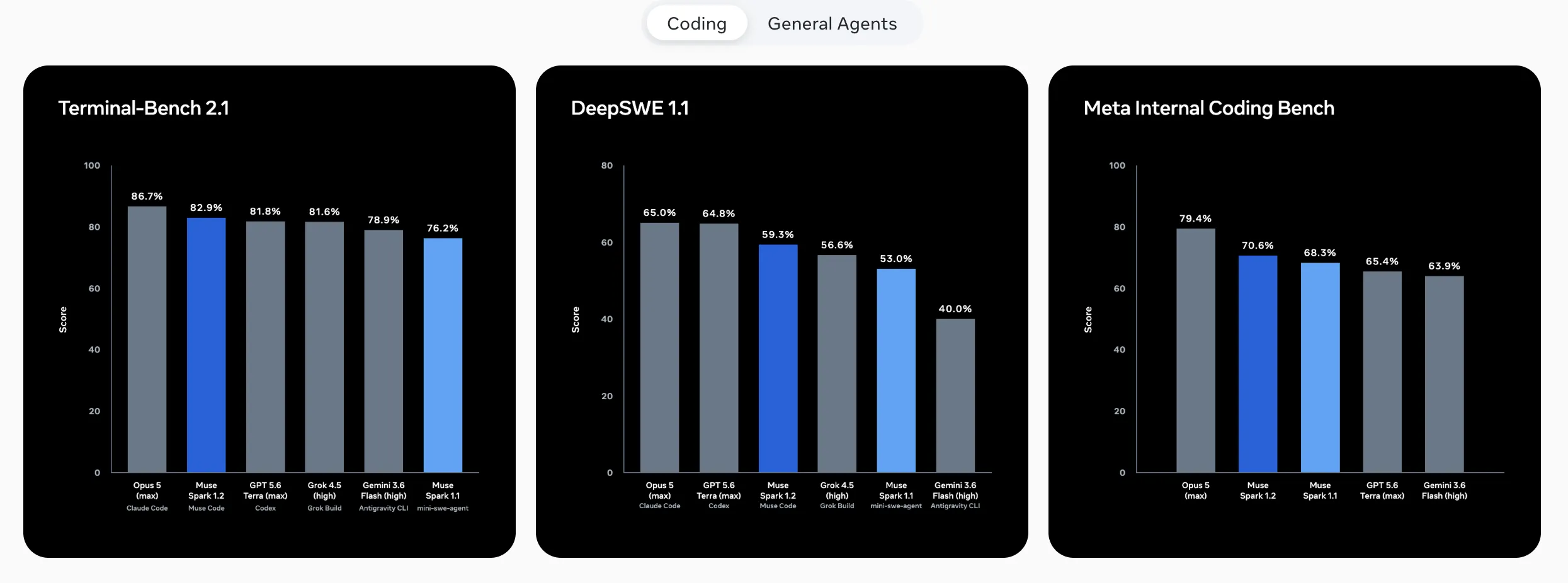
What makes the model tick is an unusual co-training setup. Muse Spark 1.2 wasn’t just trained on code; it was trained with the Muse Code harness itself, using rejection-sampled harness trajectories and recipe optimizations for goals, compaction, and subagents. Meta also used Muse Spark 1.1 to auto-generate challenging coding environments, grade candidate solutions, and produce a scalable training dataset for the 1.2 update. The evaluation methodology is refreshingly specific: Terminal-Bench 2.1 across all 89 tasks at pass@1 over five attempts, DeepSWE v1.1 on 113 tasks across 91 repos and five languages, and a 440-task internal benchmark drawn from real pull requests. Comparisons include GPT-5.6 Terra, Claude Opus 5, and Gemini 3.6 Flash, though Meta notes its harness may not be optimized for third-party models.
Meta led the launch with a GPU kernel optimization case study that’s genuinely impressive: 1,000-plus tool calls stretched across up to 24 hours, iteratively writing, compiling, profiling, and improving kernels against a provided baseline. On NVIDIA Hopper GPUs, Muse Spark 1.2 built a two-kernel Triton pipeline for MLA that reuses a shared KV latent as both K and V — beating the PyTorch reference at batch size 1 with 64 heads and sequence length 8192. The catch? No downloadable weights. This is a hosted dependency, installable via curl on macOS and Linux. Teams already running agents in sandboxes with review gates will feel right at home. Everyone else is looking at a beta that demands careful trust calibration before it touches production repos. The long-horizon training and persistence infrastructure suggest Meta is building toward something more foundational than a coding assistant — this looks like scaffolding for autonomous development workflows, assuming the safety and reliability pieces catch up.