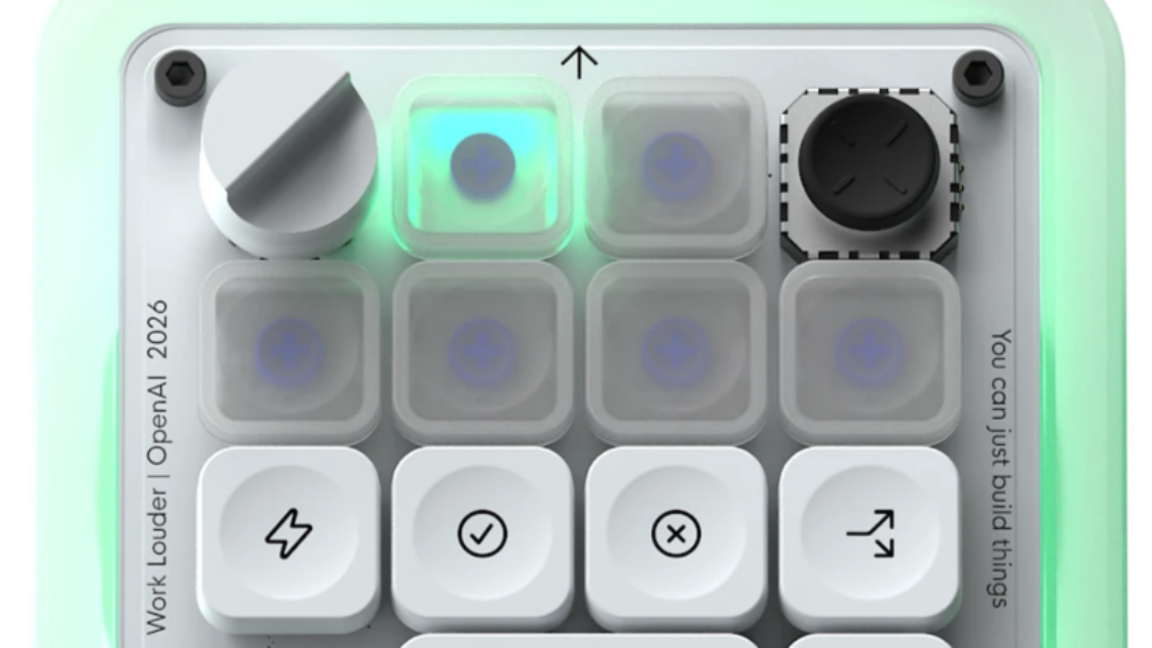
OpenAI isn’t making a speaker. Not yet, anyway. The company’s first branded device, the Codex Micro, is a niche piece of desktop kit built with Work Louder—the outfit behind those tiny, customizable Creator Micro keyboards that creatives seem to love. It’s a $230 RGB-lit mini-keyboard that exists for one reason: to let you babysit up to six Codex agents without constantly alt-tabbing. The top two rows feature frosted keys that cycle through a specific color code, turning the abstract grind of an AI thread into a glanceable dashboard. White means idle, blue means the model is chewing on a problem, green signals a finished task. Amber flashes when Codex is stuck and needs a human decision, and red screams that a thread has face-planted into an error. Tap a lit key, and the relevant Codex window jumps to the front of your screen.
Below that light show sit six more buttons mapped to common workflow commands—accepting or rejecting changes, branching threads, and a push-to-talk function for audio prompts. If you hate the defaults, the software lets you remap everything, and the box ships with 32 alternate keycaps so you can physically relabel things. The first function layer is locked to Codex, but you can program and cycle through five additional layers for mundane computing shortcuts, which at least prevents the thing from being a $230 paperweight when you aren’t actively managing agents.
The utility here is unapologetically desktop-bound. This is a peripheral for people who keep a laptop half-open on their desk, perpetually monitoring AI tasks that hum along in the background. If you’re away from your desk, ChatGPT’s mobile app offers far more detailed oversight—a notification on your phone is arguably more useful than a blinking light you can’t see. But the Codex Micro isn’t trying to compete with push notifications. It’s targeting the same impulse that drives people to buy physical stream decks: the desire for a dedicated, tactile interface that sidesteps the friction of software.
What’s genuinely interesting here isn’t the keyboard itself but what it signals. OpenAI is testing the waters for physical products through a limited-run collaboration rather than a splashy first-party launch. It’s a low-risk way to learn whether developers will pay a premium for hardware that makes an AI-native workflow feel more tangible. The $230 price tag will undoubtedly raise eyebrows—Work Louder’s standard Creator Micro sells for less—but scarcity and that glowing OpenAI logo might be enough to move units. If this thing sells out in minutes, expect more experiments where software companies dip their toes into atoms. If it languishes, it’ll be a quirky footnote in the company’s hardware ambitions.