Every AI agent eventually hits the same wall: the context window fills up, and something gets dropped. Developers building long-running agents know the symptoms well — the agent re-asks questions it already answered, contradicts decisions from earlier in the conversation, or forgets that a critical document exists at all. The fix isn’t a bigger context window. It’s understanding that retrieval and memory solve two fundamentally different problems.
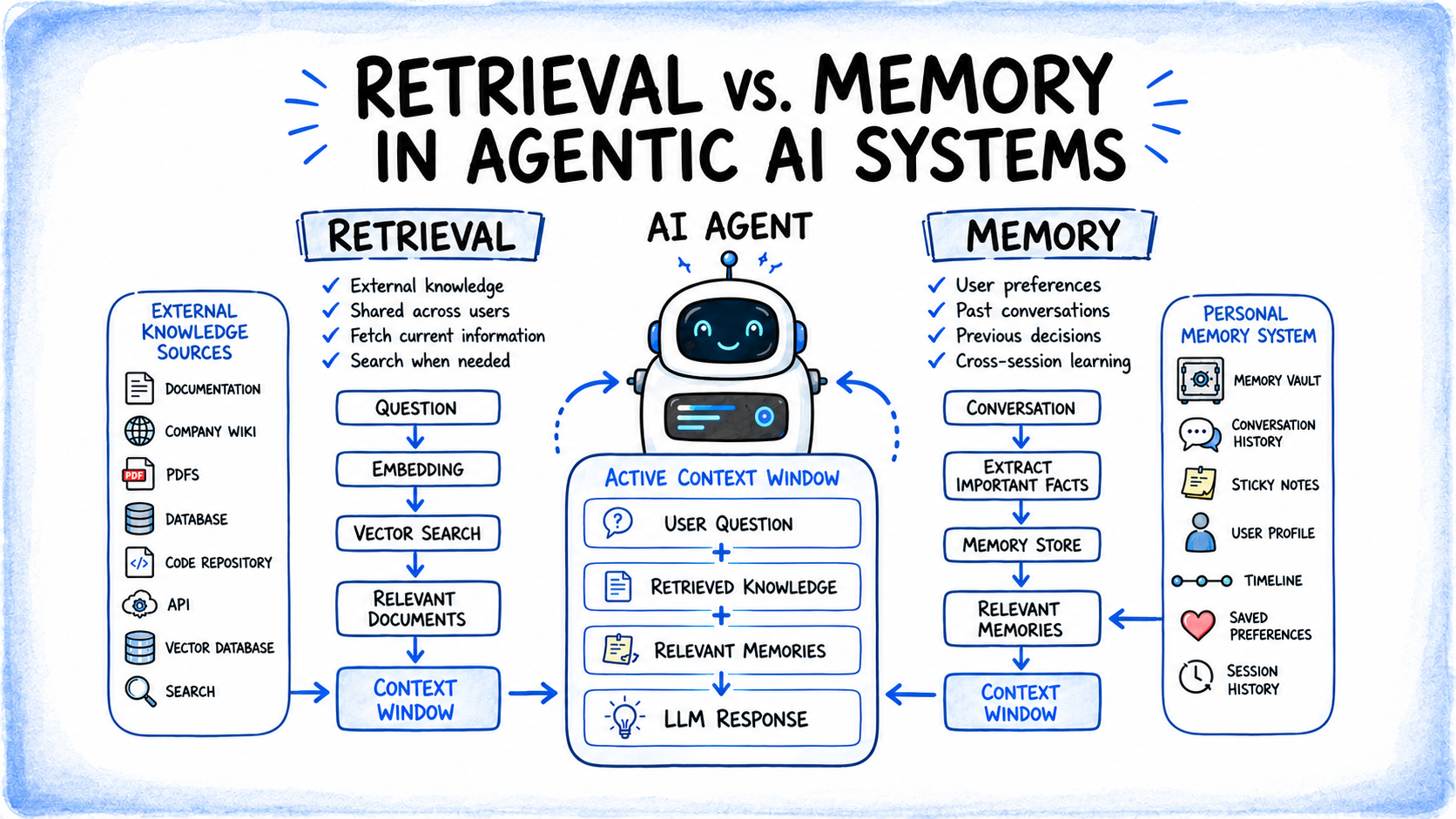
Retrieval handles information that lives outside the model entirely — documentation, code, database records, policy files. The standard approach is retrieval-augmented generation: chunk source documents, embed them into a vector index, and pull the nearest matches into the prompt when a query comes in. The corpus is shared across all users and refreshed on its own schedule, independent of any individual conversation. It answers one question: what does the world know that I don’t have in my weights or current context?
Memory answers a different question: what have I already learned or done that I need to carry forward? Short-term memory is just the running session state — the conversation so far, scratchpad notes, tool outputs. It’s cheap and disappears when the session ends. Long-term memory is where things get harder, because the agent has to decide not just what’s relevant, but what’s worth keeping in the first place. Some systems automatically extract facts and preferences from conversations and store them for later queries, much like a retrieval index — except the data comes from the agent’s own interactions rather than an external corpus.
The distinction matters because conflating the two is where agent architectures break down. Both use similar tooling — embeddings, vector search, structured stores — but they store different things from different sources. Retrieval searches a corpus outside the agent. Memory persists what the agent itself generated or learned. Build only one, and the agent either can’t access outside knowledge or can’t remember anything about its own past decisions. The agents that actually work in production combine both, treating context engineering as the discipline of curating a finite resource rather than just stuffing more tokens into a prompt.