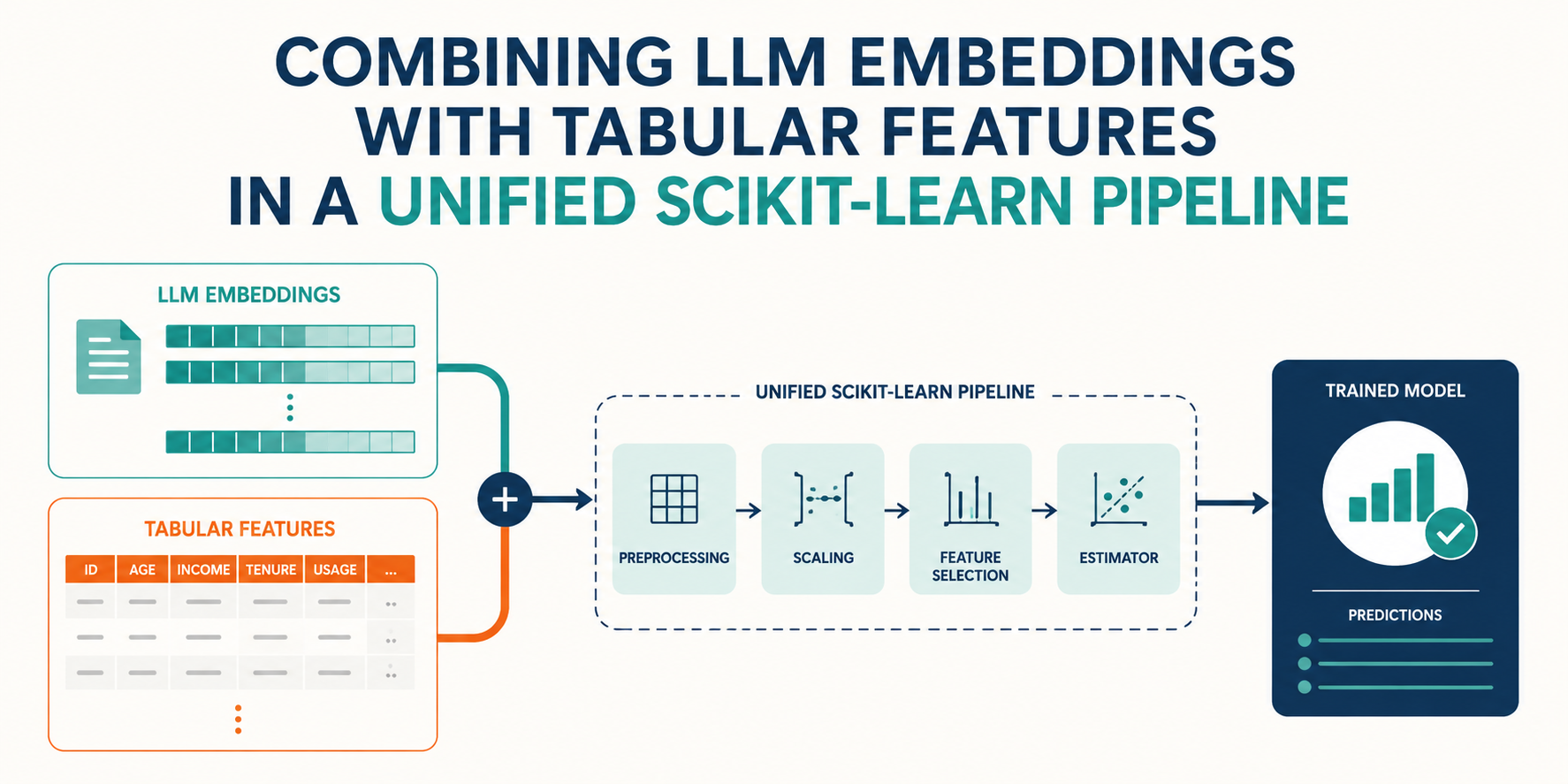
Most real-world classification problems aren’t purely text or purely tabular. A customer churn model might need to weigh a support ticket’s wording against account age, login frequency, and plan type. Yet most tutorials treat these as separate worlds. This guide bridges that gap with a single scikit-learn pipeline that runs three preprocessing branches in parallel: text embeddings via Hugging Face’s all-MiniLM-L6-v2 model, standard scaling for numeric columns, and one-hot encoding for categorical ones.
The architecture hinges on a custom transformer class inheriting from TransformerMixin and BaseEstimator. The constructor specifies the sentence-transformers model, while the transform() method maps raw text into dense embedding vectors. That custom class then slots into a ColumnTransformer alongside standard scikit-learn preprocessing steps, eliminating the manual split-and-rejoin dance that typically plagues mixed-data workflows. A random forest classifier sits at the end of the chain, making the entire pipeline trainable with a single fit() call.
The author tests the approach on a hybrid dataset: the well-known SMS Spam Collection from GitHub, augmented with synthetic tabular features designed to simulate a customer churn scenario. The synthetic attributes were deliberately given noise and overlap to avoid making the problem trivial. Results came back ‘pretty decent,’ though the author is quick to note the SMS dataset is famously easy to separate, so the strong performance shouldn’t be mistaken for evidence that the pipeline solves genuinely hard classification tasks.
What’s refreshing here is the deliberate choice to skip paid APIs like OpenAI or Gemini and skip massive models like LLaMA 3. all-MiniLM-L6-v2 runs comfortably on CPU, making this approach accessible for teams that can’t justify GPU infrastructure or per-token inference costs. The trade-off is embedding quality, but for many classification tasks, the difference between MiniLM and a frontier model matters far less than whether the pipeline is clean, reproducible, and deployable. That’s the real argument being made: architectural hygiene beats model size for most production use cases.