Pasting a massive PDF into a chat with Claude is a hidden money pit. You don’t just pay for it once. Because the model re-processes the entire conversation history on every turn, that 200-page document you attached gets billed again with each follow-up question you ask. A new open-source tool called Token Saver, built by the Marktechpost AI team, just flipped that model on its head.
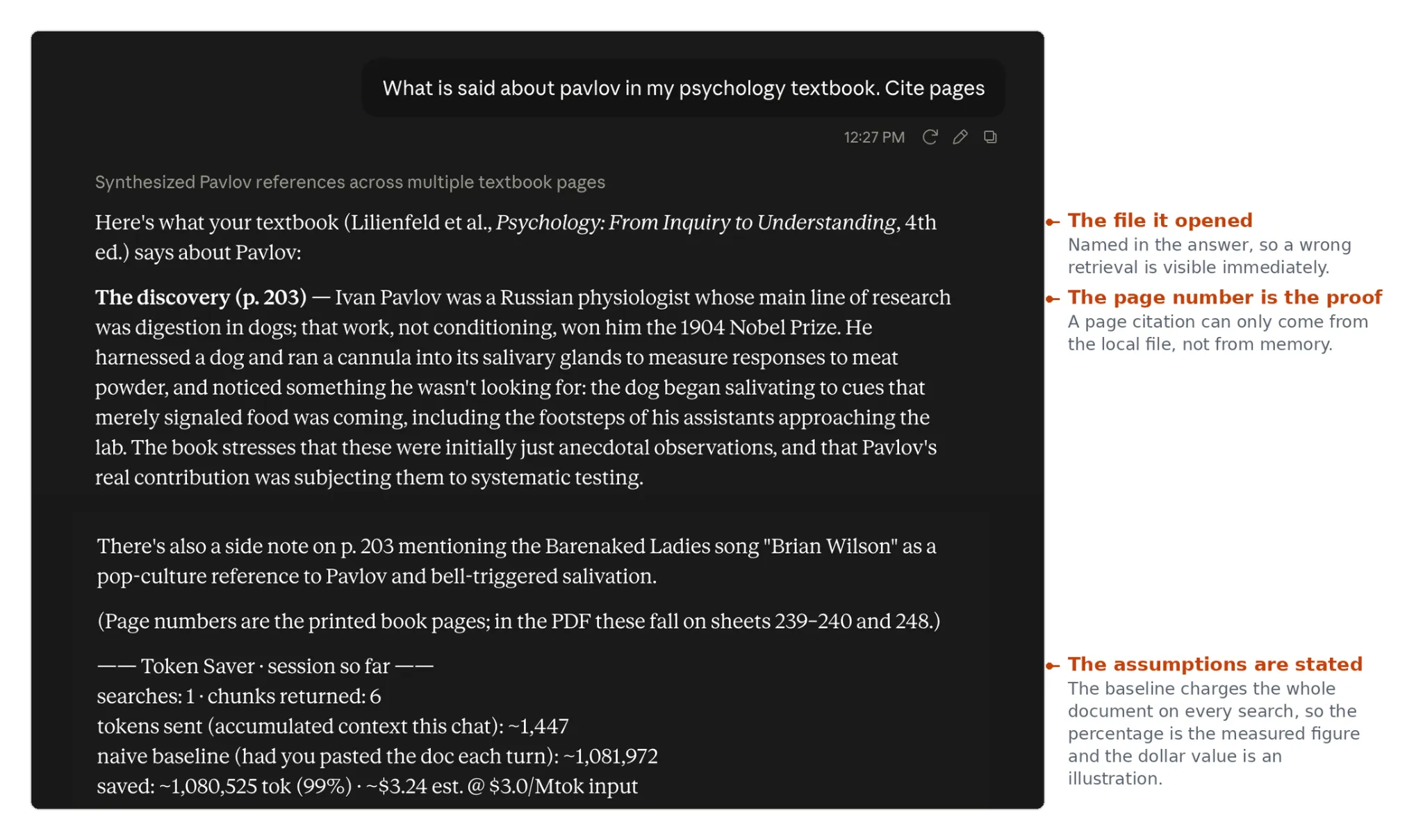
Developed by intern Arnav Rai during his time at the media company, Token Saver is a local server that acts as a middleman between Claude Desktop and your files. Instead of sending a raw PDF to Anthropic’s servers, it runs a Hybrid RAG pipeline directly on your machine — no Python environments required. When you ask a question, the system uses a mix of old-school keyword matching (BM25) and a local semantic embedding model to find the two relevant paragraphs in a thousand-page textbook. Only that tiny, relevant snippet gets sent to Claude, along with the exact page number.
The numbers are stark. According to benchmarks measured via tiktoken, the token savings are not marginal; they are exponential. A single question against a 1,000-page document costs about 3.1 million tokens if sent raw. Token Saver brings that down to roughly 2,300 tokens. That’s a 99.9% reduction. Even for a 10-page file, costs drop by 92%.
Security is baked into the architecture for professionals who deal with sensitive legal or financial documents. The server talks to Claude over standard I/O, meaning it has no open network ports to exploit. You whitelist a single folder on your hard drive, and the tool refuses to read anything outside of it. The PDF never touches the cloud. For anyone tired of watching their API credits evaporate while searching for a single clause in a contract, this feels less like an optimization and more like a necessary correction.


