Managing large language models often feels like wrangling chaos, especially when you swap backends or tweak prompts. This guide cuts through the noise by pairing Scikit-LLM with MLflow, two tools that bring structure to LLM experimentation. The core idea is simple but powerful: treat your LLM pipelines like traditional scikit-learn estimators. By doing so, you gain the ability to log, compare, and version models with the same rigor applied to classical machine learning tasks.
The process starts with configuration. You install Scikit-LLM with specific extra options to ensure compatibility, then set up dummy credentials to enable local execution of models like gpt4all. MLflow handles the heavy lifting of tracking, using a database backend to store experiment data. The article walks through initializing an experiment named “Scikit-LLM-Versioning” and defining a small labeled dataset for zero-shot classification. This setup ensures that every run is reproducible, a critical feature when model weights or backend libraries update frequently.
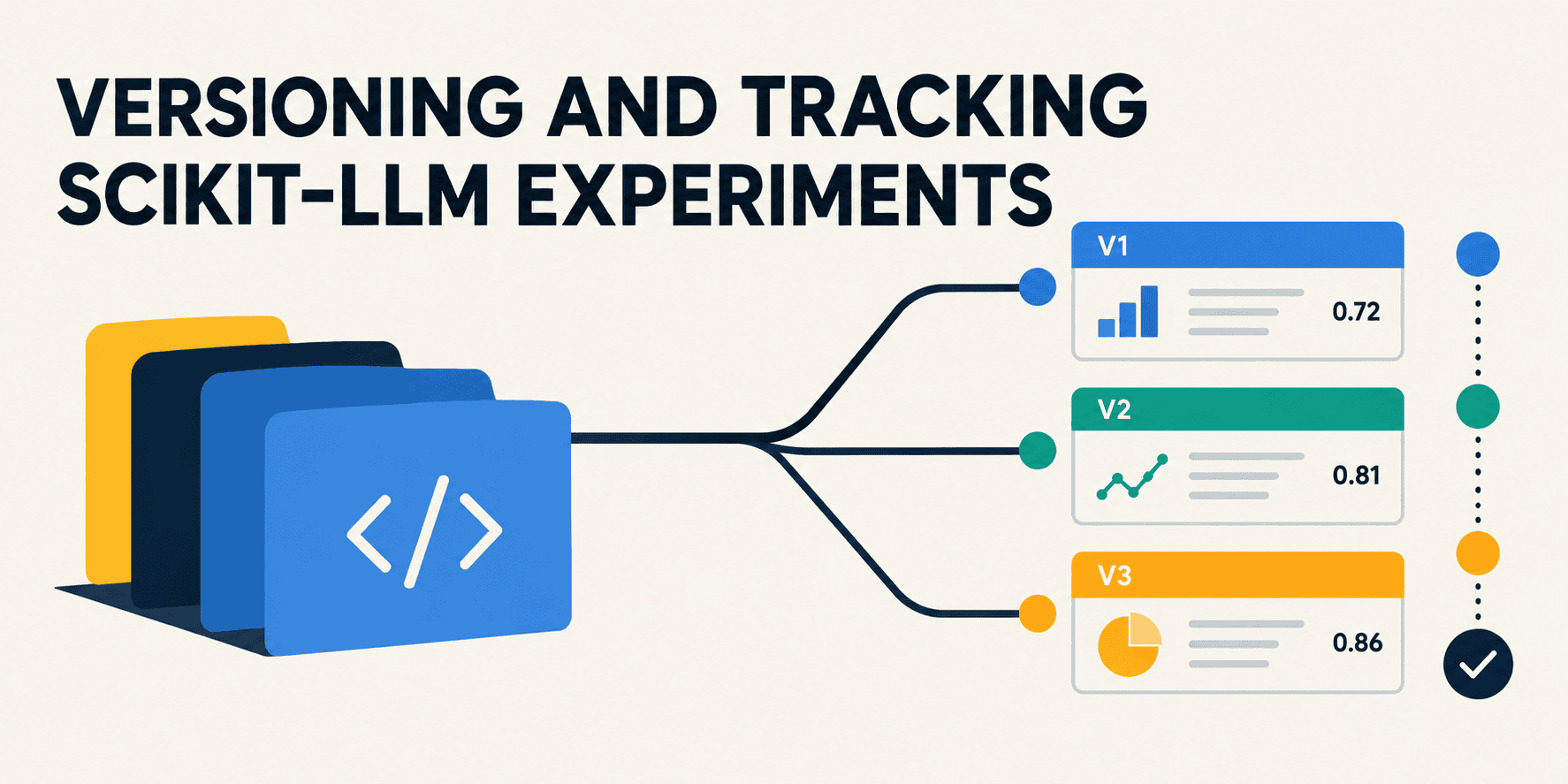
Logging happens in distinct blocks. First, a baseline pipeline uses the Orca Mini model, logging parameters like the backend type and model file string via cloudpickle serialization. This generates a unique run ID. Next, an upgraded pipeline swaps in a heavier Falcon model (ggml-model-gpt4all-falcon-q4_0.bin). By isolating this in a separate MLflow run named “Upgraded_Falcon,” you create a clear audit trail. This side-by-side comparison allows developers to see exactly how changing the underlying LLM affects performance without losing track of previous iterations.
Finally, the workflow moves from logging to registration. Using MLflow’s search API, you can extract experiment data into a pandas DataFrame, filtering for successful runs while ignoring failed attempts. The guide demonstrates promoting the best-performing pipeline—identified either manually or by highest accuracy—into the Model Registry as Version 1. This two-step approach keeps the registry clean and production-ready. It suggests that treating LLMs as standard ML components isn’t just possible; it’s the most sustainable way to manage them at scale.