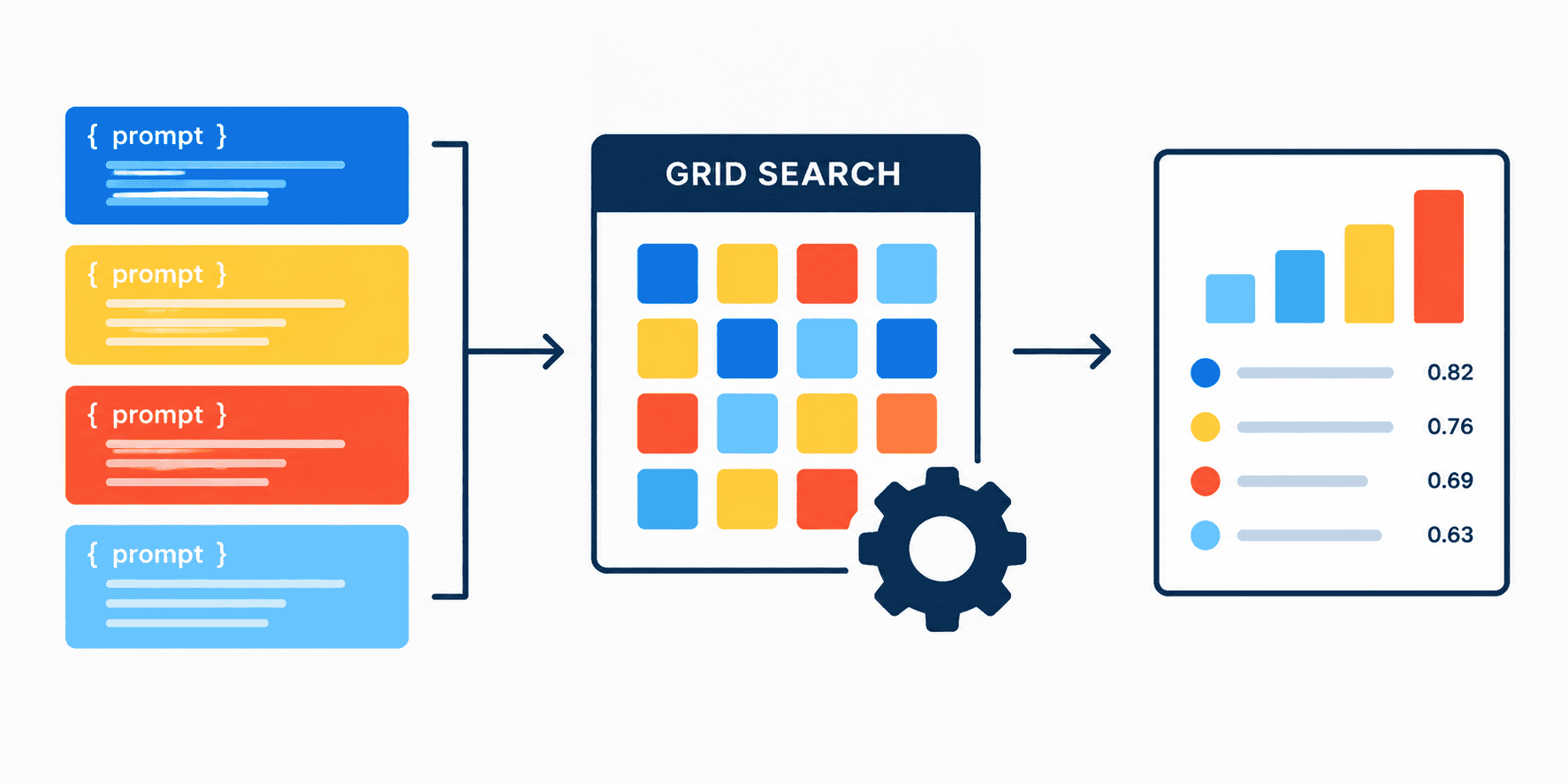
Stop guessing which prompt works best. Start testing them like code. A new approach treats natural language instructions as tunable hyperparameters, applying the rigor of traditional machine learning to the often fuzzy world of prompt engineering. By wrapping a language model in a scikit-learn-compatible classifier, developers can automate the search for optimal phrasing rather than relying on intuition or manual A/B testing.
The method hinges on a custom class that inherits from scikit-learn’s BaseEstimator and ClassifierMixin. This wrapper allows any zero-shot text classification task to plug into established optimization pipelines. Instead of training weights, the system swaps out prompt templates. The article demonstrates this using “Qwen/Qwen2.5-0.5B-Instruct,” a lightweight and free model choice that keeps iteration costs low. The predict() method handles the heavy lifting, formatting inputs as chat messages to steer the model toward instruction-following behavior rather than raw text completion.
To validate the concept, the author runs a cross-validated grid search over a tiny four-sample dataset. While the sample size is deliberately small for demonstration purposes, the mechanics scale. The system tests multiple candidate prompts, scoring each on classification accuracy. The result isn’t just a better prompt; it’s empirical evidence of which linguistic structure the model prefers for a specific task. This moves prompt selection from art to science, providing a clear metric for performance.
This technique bridges a critical gap between classical ML workflows and modern generative AI. Data scientists already trust grid search for tuning learning rates or tree depths. Applying the same logic to prompts means existing MLOps tools can manage language variables without major refactoring. However, caution is necessary. As the dataset grows, so does the computational cost of evaluating every template combination. For production systems, random search might offer a better trade-off than exhaustive grids. Still, the core insight remains powerful: if you can measure it, you can optimize it.