webAI just dropped a pair of small language models that don’t do poetry or chat — they do formal logic. TwIL-LM comes in 1.7B and 3B sizes, and both are built for a very specific, very unsexy job: translating English sentences into first-order logic and then checking whether a conclusion actually follows from the premises. The 3B version, TwIL-LM3, is a merged fine-tune of SmolLM3-3B that ships as a 1.78 GiB quantized file. It runs on a CPU or 4 GB of VRAM, which is the whole pitch for regulated industries like healthcare and finance where data can’t leave the device.
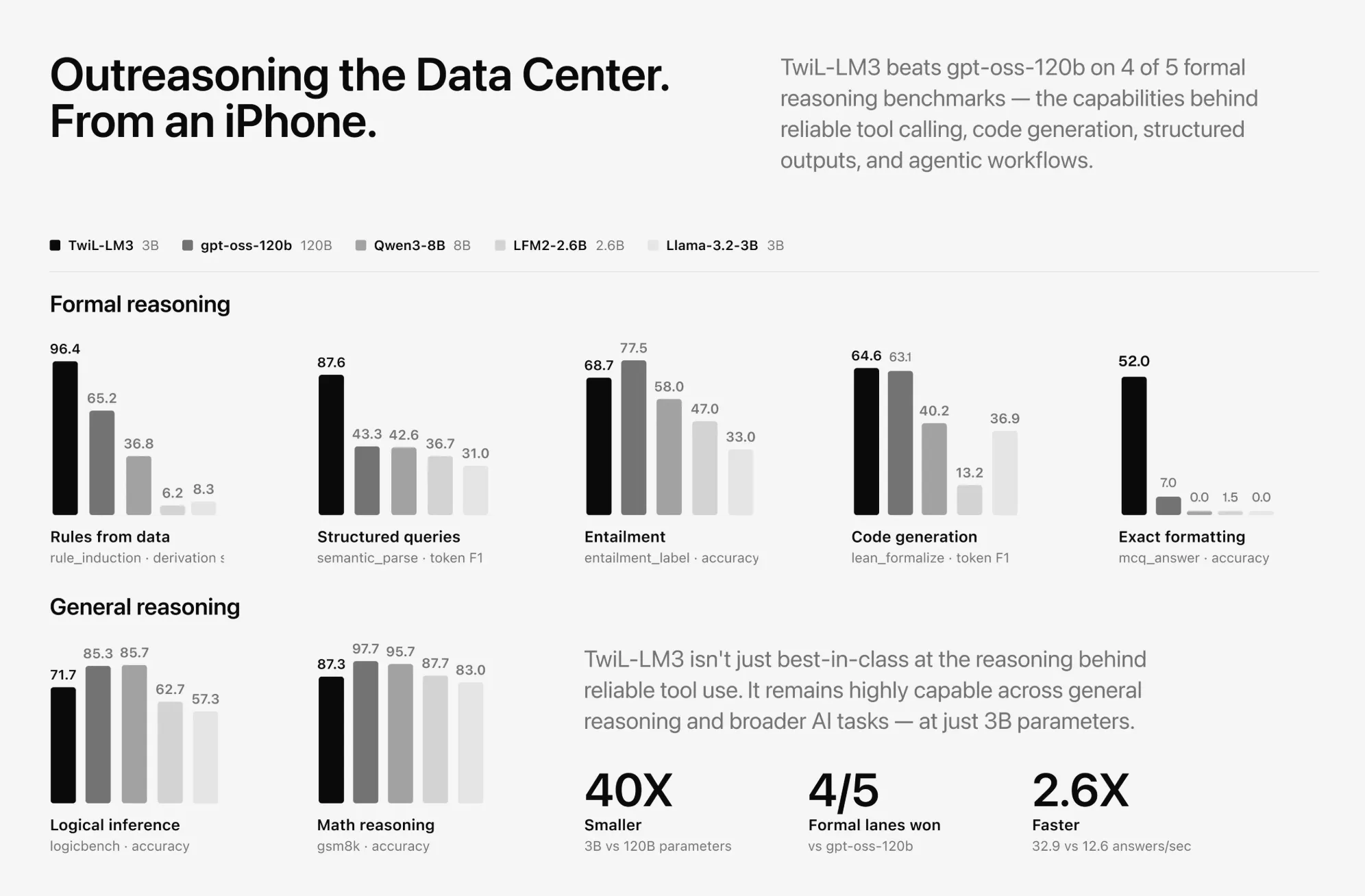
The performance story is a split decision. On a six-lane formal reasoning benchmark, TwIL-LM3 scores 0.4488 — trailing gpt-oss-120b’s 0.5192. But flip to strict-7 scoring, where loose-match credit disappears, and the gap nearly vanishes: 0.2093 for Qwen3-8B versus 0.1971 for TwIL-LM3. Where the model actually wins is throughput. It spits out 32.9 answers per second with an average generation length of just 482 tokens. The 120B model? 4.2 answers per second. For a compliance officer running through a stack of contract clauses at their desk, that’s the difference between a tool you use and one you curse at.
The training recipe is where things get genuinely interesting. webAI used WiSE-FT interpolation at lambda equals 0.25 — keeping only a quarter of the fine-tuned delta and pulling the rest back toward the base model. A sibling arm that skipped this step scored higher in-domain but bled roughly twelve points on held-out benchmarks. TwIL-LM3 actually gained on both tracks simultaneously: a 26% relative bump in-domain and a 0.022 improvement on the held-out core average. That’s rare. Most small-model fine-tuning projects pick one lane and stay in it.
The catch is the license. Both models ship under webAI’s Non-Commercial License 1.0. You can tinker, you can run it locally, but if you want to build a product on top of it, you’ll need a separate agreement. That’s going to irritate the open-source purists, but it’s also a signal that webAI sees this as more than a research artifact. Between the local-only deployment story and the compliance-targeted framing, they’re clearly positioning this for enterprise deals — not Hugging Face clout. Whether a 3B model can hold its own against the reasoning giants coming out of labs like DeepSeek and Anthropic is an open question, but for the narrow slice of work it targets, TwIL-LM3 doesn’t need to be the smartest model in the room. It just needs to be fast, private, and logically sound.