A model that predicts accurately and a model whose reasoning you can defend are not the same thing. The EU AI Act’s Article 13 has made that distinction a compliance issue, not a philosophical one. High-risk AI systems now need enough transparency for deployers to actually interpret outputs. That means the customer churn model flagging your five-year loyal customer as high-risk isn’t just an edge case—it’s a decision someone has to explain to a manager, a customer, or a regulator.
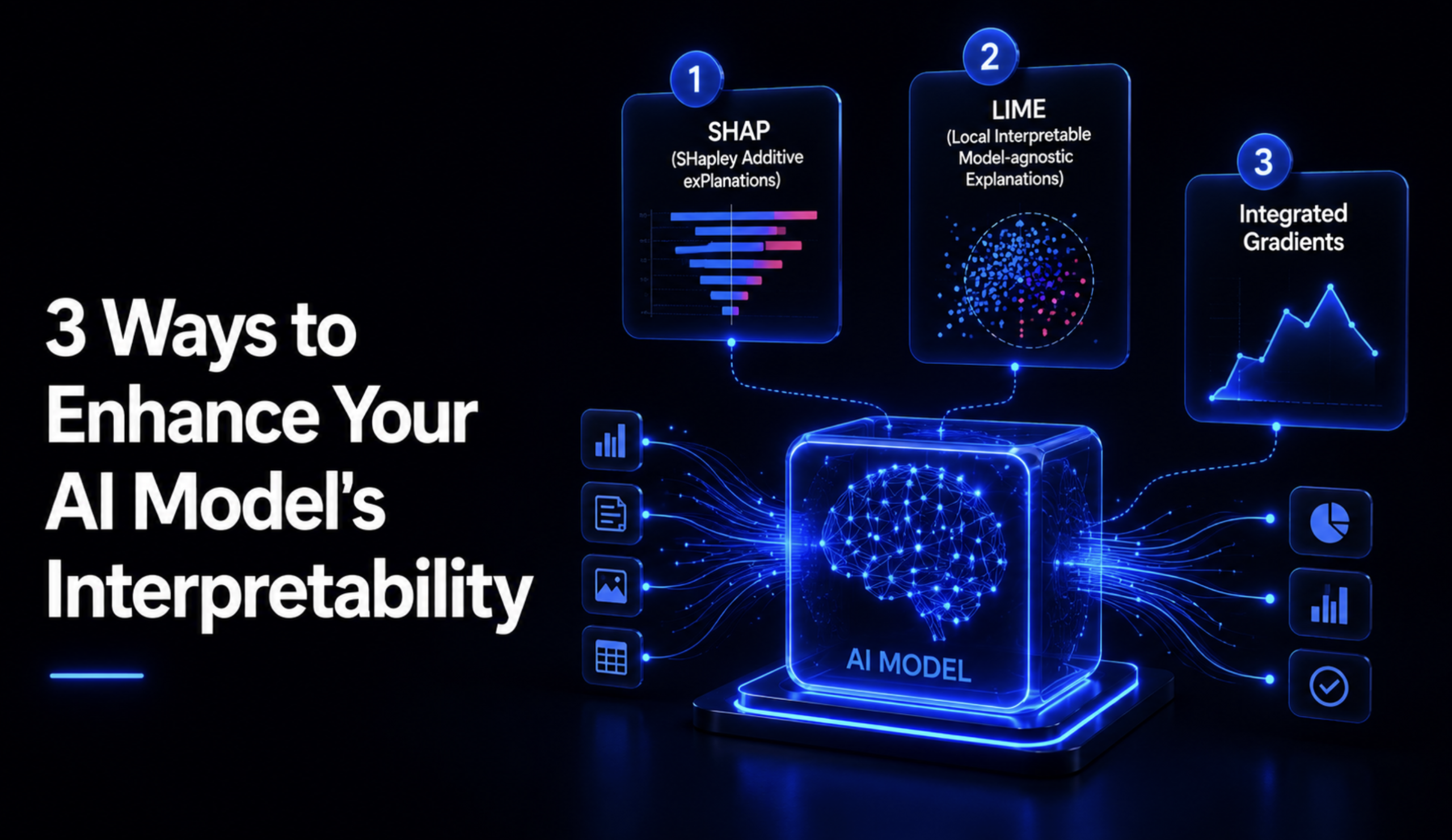
The article walks through three concrete techniques—SHAP, LIME, and Integrated Gradients—applied to the same churn prediction problem, first with a gradient-boosted tree and then a small neural network. The traditional approach, pulling scikit-learn’s .feature_importances_ attribute, gives you a global ranking: tenure at the top, then monthly charge, support tickets, contract type, late payments. But that ranking has three structural blind spots. It’s global-only, so it can’t explain a single prediction. It’s biased toward high-cardinality features, inflating importance simply because a variable offers more split points. And it vanishes entirely the moment you’re working with a neural network or a black-box API.
What makes the comparison useful is the dataset itself. The churn labels aren’t random noise—they’re generated from a known logistic relationship where short tenure, month-to-month contracts, and high support-ticket counts genuinely drive churn probability. Since the true underlying drivers are known in advance, every explanation technique can be tested against ground truth rather than vibes.
That kind of controlled setup is rare in interpretability discussions. Most articles demonstrate techniques on datasets where nobody actually knows what the model should be finding, so any plausible-looking explanation gets accepted. Here, a technique either recovers the injected relationships or it doesn’t. The stakes are higher than they look: if an explainer can’t identify drivers the authors deliberately baked into the data, why would you trust it on production data where you have no ground truth at all?


