Alibaba’s Qwen team has dropped Qwen3.8-Flash-Next, an open-weight multimodal Mixture-of-Experts model that’s being positioned as the architectural preview for Qwen4 — the same way Qwen3-Next telegraphed what was coming in Qwen3.5. The headline number: training cost came in at roughly one-ninth that of Qwen3.7-Plus. That’s not a marginal efficiency gain. That’s the kind of reduction that changes what teams can afford to attempt.
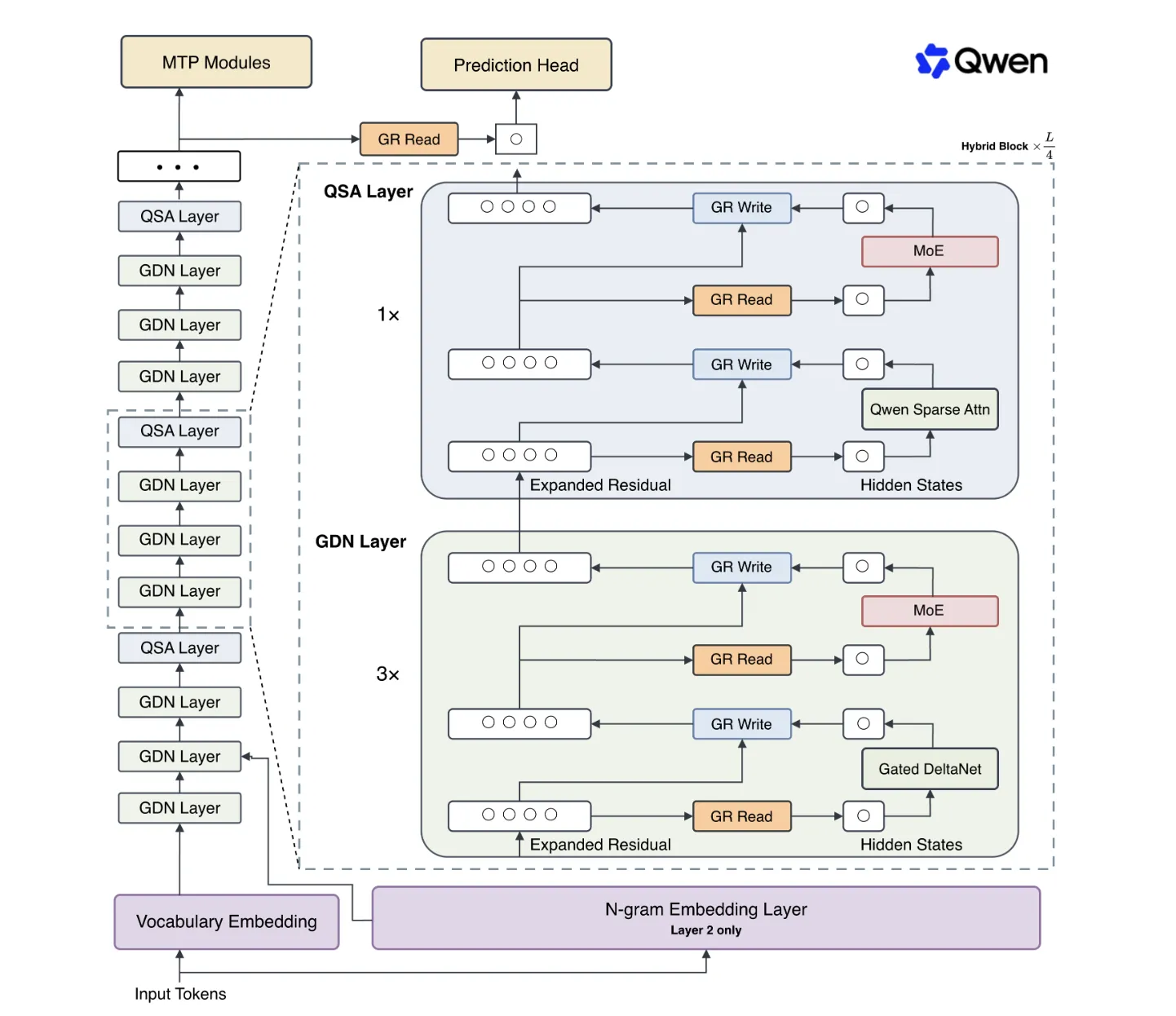
The architecture is genuinely unusual. A 125B backbone sits alongside a 51B N-gram embedding table and a 4B multi-token prediction module — 180B parameters on disk, but only 6B activate per token. Three of every four layers use Gated DeltaNet, a linear-attention mechanism that compresses context into a fixed-size recurrent state. The fourth layer runs Qwen Sparse Attention, which selects context at micro-block granularity rather than per token. There’s also a Gated Residual stream that splits into four parallel branches with bottleneck rank 320, plus a 20-million-entry bigram/trigram lookup table at layer 2. It’s a lot of moving parts, and the fact that Qwen got it to train at all — let alone at one-ninth the cost — suggests the Muon optimizer applied alongside AdamW is doing real work.
Benchmarks tell a mixed story. Qwen reports 58.7 on DeepSWE 1.1, 62.5 on SWE-bench Pro, and 91.9 on LiveCodeBench v6 — strong coding numbers. Agentic tasks show 73.9 on CoWorkBench and 55.7 on JobBench. But the model doesn’t lead everywhere: Claude Opus 4.6 (Max) takes HLE at 40.0 versus Qwen’s 35.9, and DeepSeek-V4-Flash-0731 leads NL2Repo-Bench at 54.2 versus 48.1. Frontier reasoning remains the gap, and Qwen isn’t pretending otherwise.
Self-hosting is where reality bites. The FP8 checkpoint is 172.78 GiB; BF16 is 335.28 GiB. Minimum validated FP8 configuration is TP2 on GB300, with TP4 recommended. On an 8×H200 node you need TEP8 — plain TP8 won’t work with the checkpoint’s 128-wide quantization blocks. The sparse activation cuts compute, not storage, so you’re still paying for the full 180B on disk. Context runs 262,144 tokens natively, extensible to 1M via YaRN, and Qwen cites QSA kernel speedups up to 7.6× prefill and 4.9× decode at 1M tokens — vendor-reported numbers worth treating skeptically until independent benchmarks land. The license is qwen-community-1.0, not Apache-2.0, so commercial teams need to read the terms. For a preview model, this is more than a tech demo — it’s a statement about where Qwen thinks efficient architecture is heading.