Alibaba’s Qwen team just flipped the switch on general availability for Qwen3.8-Max and confirmed that open weights for the 2.4-trillion-parameter mixture-of-experts model ship next week. If you’re running a hosted stack, you can integrate it today through an OpenAI-compatible API at $2 per million input tokens and $6 per million output tokens. If you’re planning to self-host the flagship model, pump the brakes — this is a multi-node datacenter artifact, and Alibaba still hasn’t disclosed the activated parameter count, which makes cost modeling impossible right now.
The on-premise story is actually Qwen3.8-27B, a smaller checkpoint shipping alongside the flagship that fits on ordinary GPU hardware. That’s the one most teams will actually deploy. For everyone else, the API comes with a 1-million-token context window (991K input, 131K output), function calling, structured outputs, and five built-in tools including a code interpreter and web search. Rate limits sit at 2 million tokens per minute and 15,000 requests per minute. The pricing structure reveals where Alibaba is pushing efficiency: cached input runs $0.25 per million tokens, eight times cheaper than fresh input, so designing prompts with stable prefixes is suddenly a cost optimization exercise rather than an afterthought.
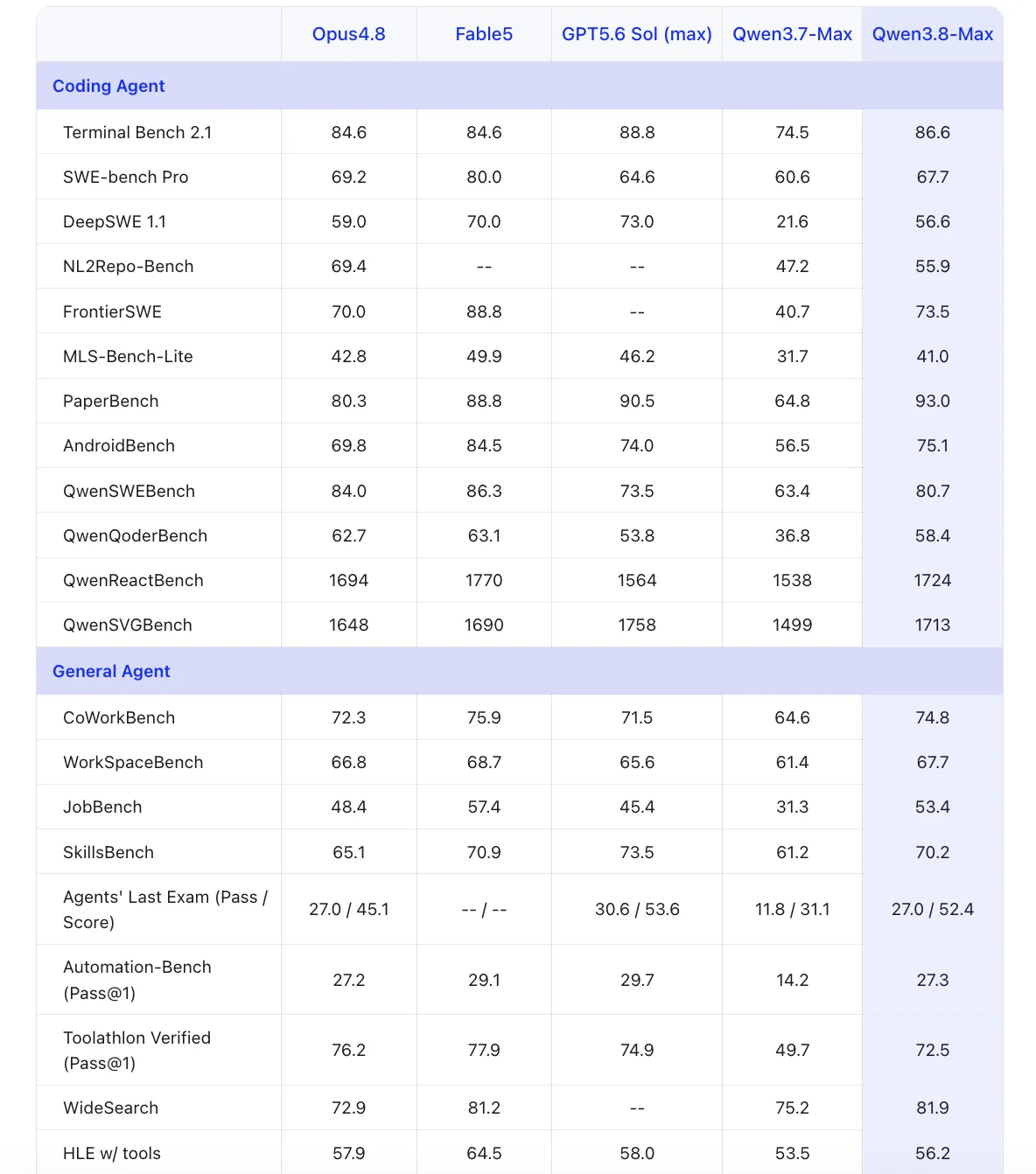
The benchmark table tells an interesting story. On Terminal-Bench 2.1, Qwen3.8-Max scored 86.6, slotting in ahead of Claude Opus 4.8 and Claude Fable 5 at 84.6 but behind GPT-5.6 Sol at 88.8. It leads on PaperBench and IFBench, and the multimodal gains are genuinely strong — OSWorld-Verified 86.1, OmniDocBench 92.1. But the code benchmarks reveal the gap: SWE-bench Pro lands at 67.7 against Fable 5’s 80.0, and FrontierSWE hits 73.5 against 88.8. The biggest year-over-year jumps are agentic — DeepSWE 1.1 vaulted from 21.6 to 56.6, JobBench from 31.3 to 53.4 — which suggests Alibaba focused reinforcement learning spend on making the model act in environments rather than just think through problems.
Two details in the benchmark section deserve scrutiny. Alibaba compared the multimodal results against Qwen3.7-Plus, not the previous Max variant, which inflates the apparent generational leap. And their own RL scaling curve peaked at 0.725 around 4,000 training environments before declining to 0.689 — a classic over-optimization signal that raises questions about whether further scaling buys much. The model maps cleanly onto four industries: software engineering, legal and financial document review, media and e-commerce operations, and design. But the real test starts next week when researchers can inspect the weights and, presumably, a license that tells us what “open” actually means here.

