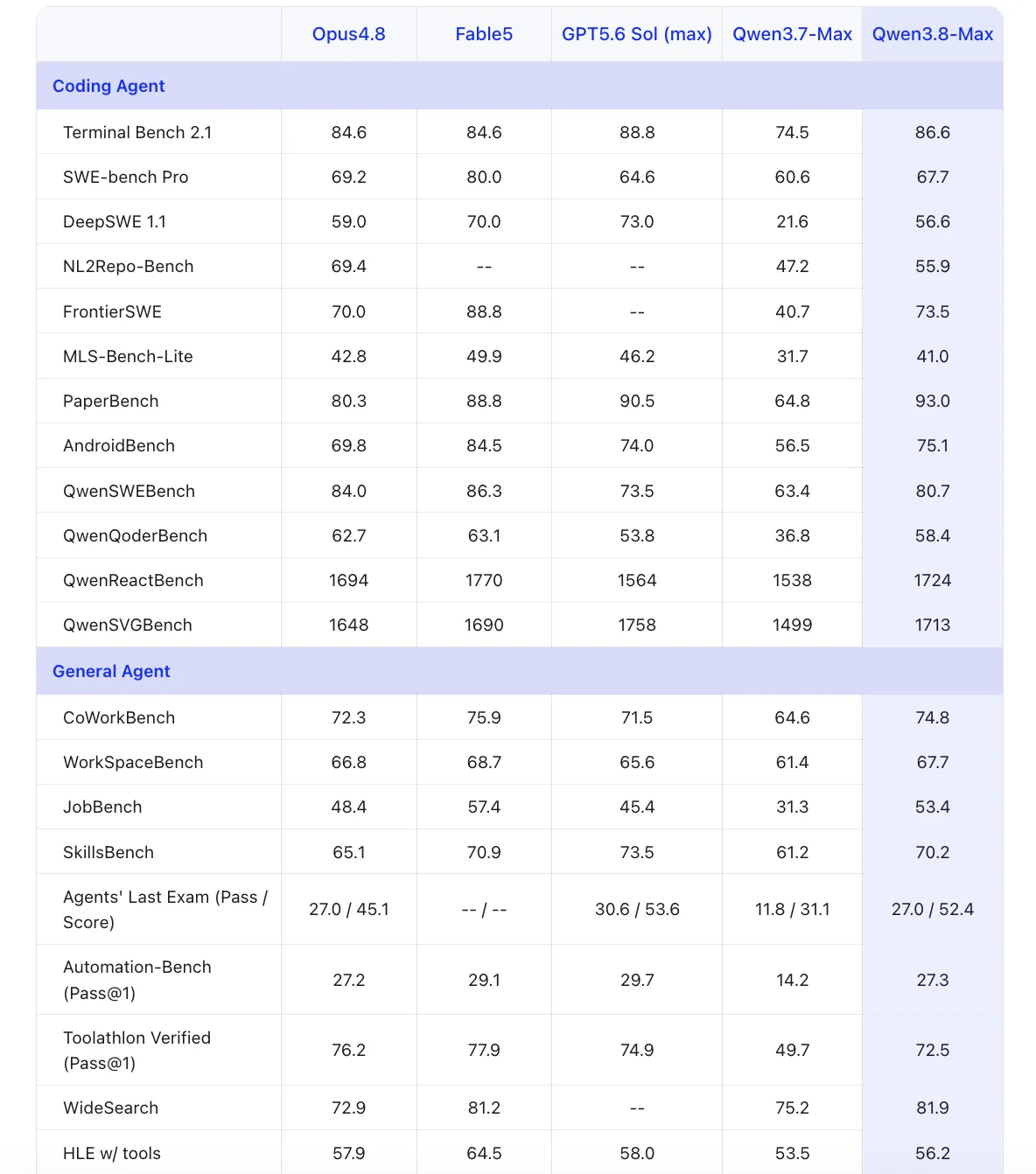
Alibaba just dropped a model that doesn’t just answer prompts — it clocks in for a multi-day shift. Qwen3.8-Max, a 2.4-trillion-parameter behemoth with 95 billion active parameters per query, is designed for long-horizon autonomous work. The Qwen team is releasing the weights next week, marking the first time a Max-class model gets this open treatment.
Let’s skip the vague ‘agentic’ label and look at what it actually did. In one case study, the model spent 16 days single-handedly building a command-line tool called oh-my-cli, managing 265 commits and 127 pull requests without human intervention. Another test had it reproduce and then beat a research paper’s results on the AIME24 math benchmark by 2.7 points, iterating through 18 of its own ideas across 33 GPU training jobs. It’s a concrete demonstration of AI not just executing a plan, but formulating and testing its own hypotheses.
The most striking result is arguably the E-Commerce-Bench simulation. Operating on anonymized Taobao and Tmall data, Qwen3.8-Max ran multiple online stores for a simulated fiscal year, starting with 100,000 yuan. It negotiated with suppliers, adjusted pricing, managed returns, and navigated crises like supply chain disruptions — all while sniffing out 152 scammers hidden in the supplier pool. It quadrupled its money, finishing with 416,252 yuan, which is 38% more than the runner-up GLM 5.2 and over 2.5 times what its predecessor managed. The model made an aggressive early investment that paid off with a six-figure profit during the holiday season.
What’s genuinely new here isn’t just scale, but sustained autonomy. In a chip design task, the model started with a bloated 8,298-gate circuit and, over roughly 500 iterations, carved it down to just 678 gates — an 81% reduction in physical chip area after layout. The Qwen team noted it kept making deep structural changes even late in the process, rather than plateauing with surface-level tweaks. Pair that with a multimodal benchmark win against 458 out of 526 human teams in a WWW2025 competition, and you start to see a shift from AI as a tool you prompt to AI as a colleague you hand a multi-week project brief. The open-weight release next week will tell us if this is a real platform shift or just a very expensive demo.