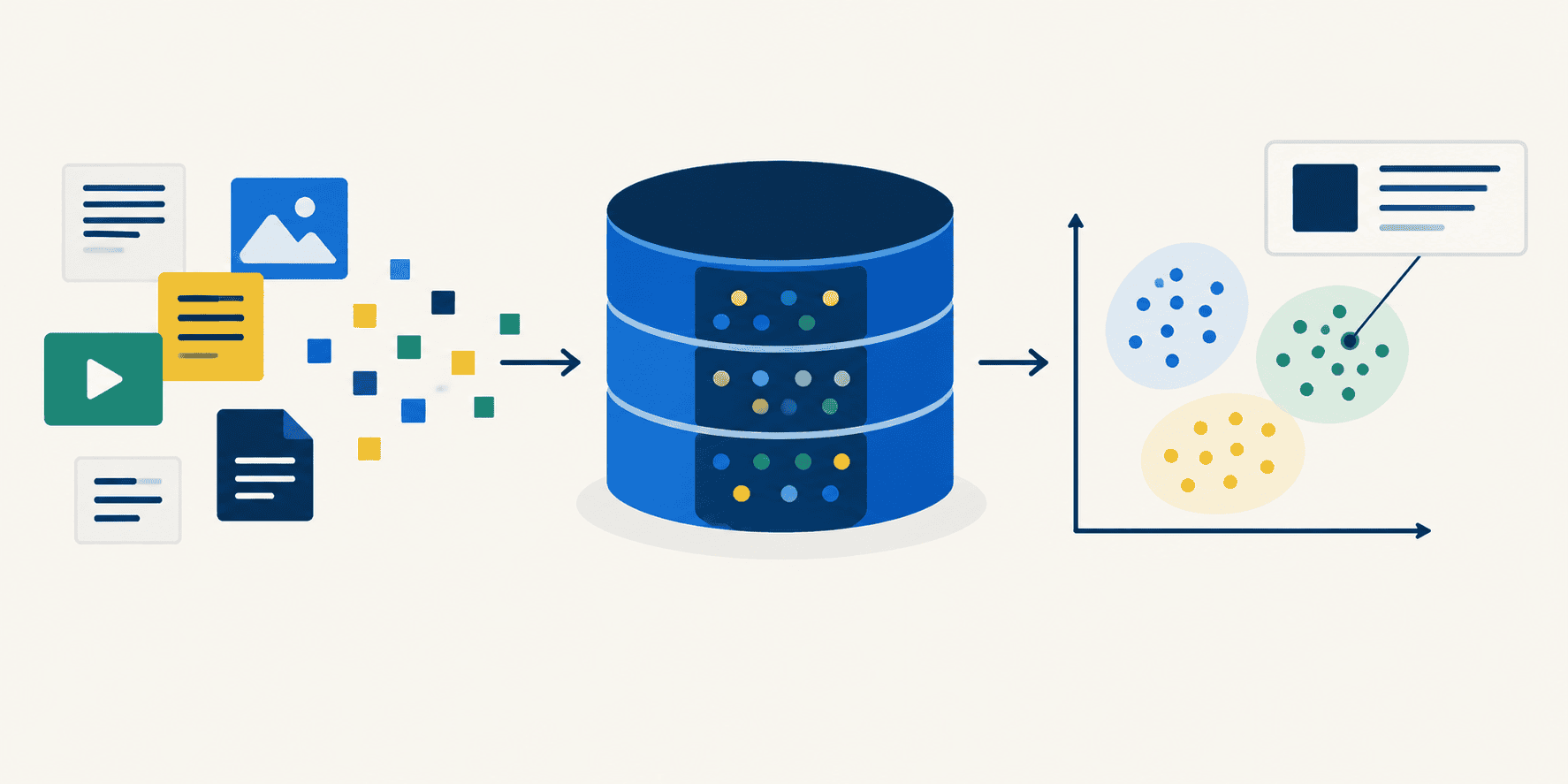
Forget the hype around massive infrastructure for a second. You don’t need a GPU cluster or a pricey API key to understand how modern AI search actually works. A new tutorial breaks down the mechanics of vector databases into ten digestible steps, using nothing more than Python and NumPy. The result is a functional, minimal database that proves semantic search is accessible to anyone willing to look under the hood.
The core magic lies in how data is represented. Instead of matching keywords, the system encodes every document into a fixed-size vector of 384 numbers. Whether you are indexing a six-word sentence or a six-page essay, the storage footprint remains a predictable 1,536 bytes per item. This uniformity makes scanning cheap and fast. When you query the system, it converts your question into a similar vector and finds documents pointing in the same mathematical direction. The results are striking: a query about “bread” successfully retrieves documents about “loaf” and “sour” even though those specific words never appear in the prompt. Keyword matching would have failed completely.
However, raw similarity has blind spots. The tutorial highlights a critical trap where a comic book description of Thor’s “mitochondria-rich muscle fibres” ranks highly for a biology question. Without context, the math sees a match; with context, it’s noise. This is where metadata filtering becomes essential. By adding simple tags like {"topic": "biology"}, you can rule out irrelevant matches before ranking them. The guide also emphasizes strict input validation. Since a bare string is iterable in Python, a simple coding error could silently split a document into individual characters, corrupting the index. Guard rails prevent this by ensuring documents, metadata, and vectors stay in lockstep.
Persistence is handled without complex dependencies. Vectors are saved to compact .npy files, while text and metadata go into readable .json formats. Crucially, the load function refuses to mix embeddings from different models. Combining vectors from disparate sources doesn’t just reduce accuracy; it produces confident nonsense. This hands-on approach strips away the abstraction layers of commercial tools, revealing that the foundation of AI search is surprisingly straightforward arithmetic. If you can manage a NumPy array, you can build the engine powering today’s most advanced chatbots.