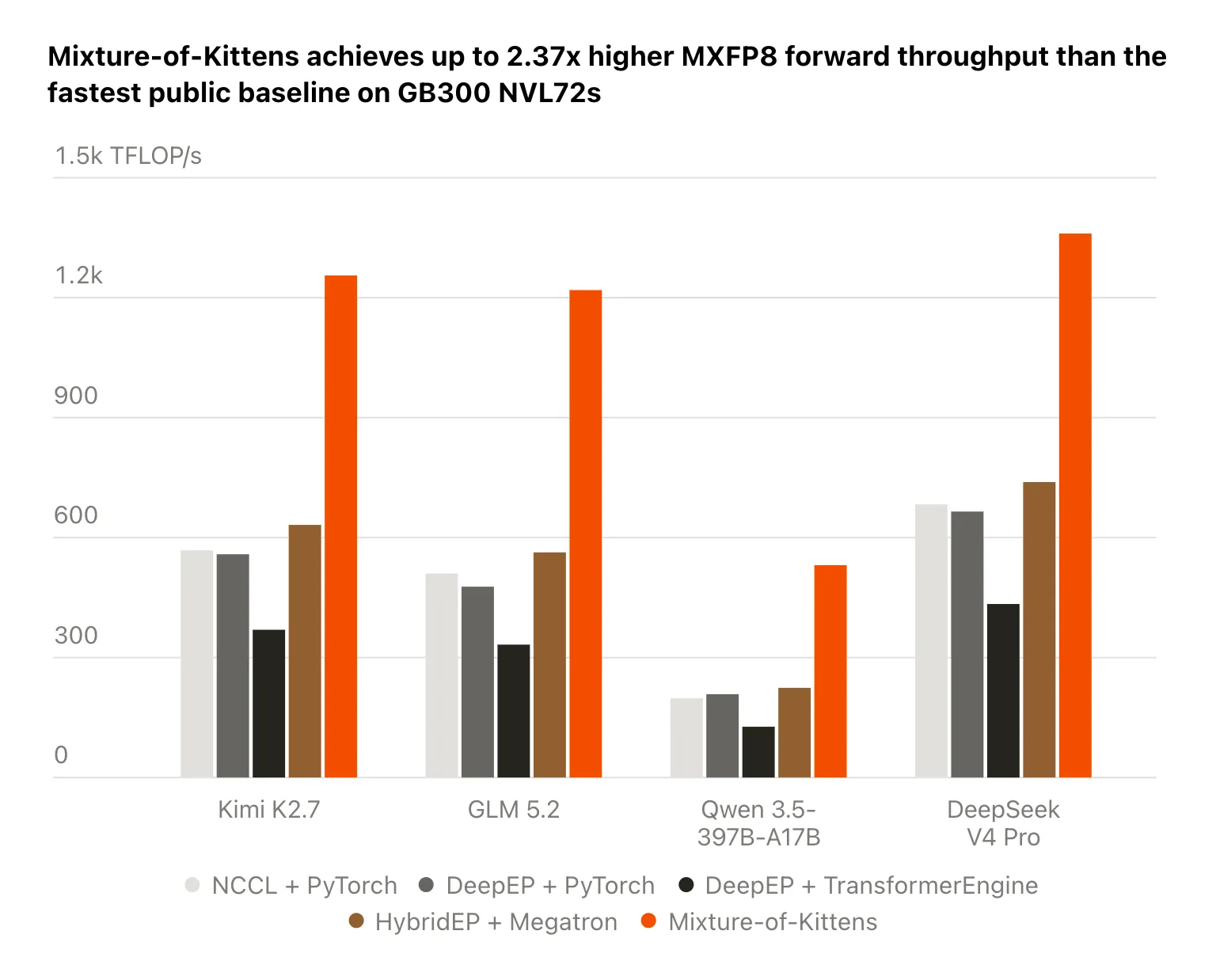
Cursor just open-sourced the secret sauce behind its Composer models, and it’s not for the hobbyist crowd. The Mixture-of-Kittens (MoK) megakernel fuses every step of mixture-of-experts communication and computation into a single, deterministic operation. It’s the engine that already powers Composer training across tens of thousands of GPUs, and the team reports throughput gains of up to 2.37x over the fastest public baseline.
The catch? You’ll need a GB200 or GB300 NVL72 rack to run it. MoK targets NVIDIA Blackwell SM100 and SM103 GPUs exclusively, alongside Python 3.12+, PyTorch 2.10+, and CUDA toolkit 13.0+. That hardware floor eliminates single-node teams and 8-GPU shops immediately. The realistic user base shrinks to frontier labs, well-funded model startups, GPU neoclouds, and national computing centers — the kind of organizations that can write a check for a $2 million rack without flinching. Cursor’s team had to solve a specific bottleneck: the MoE layer was chewing up more than half of end-to-end training time once they moved compute to custom MXFP8 and NVFP4 kernels. Communication, not computation, became the wall.
Three design choices separate MoK from existing approaches like DeepEP and Comet. First, the team rejected push-based transfers for dispatch after microbenchmarks revealed push leaves reverse NVLink lanes largely idle. Pull-based dispatch delivered up to 29% higher NVLink bandwidth utilization under expert imbalance and slashed dispatch signalling latency from 103 µs to 18 µs. MoK uses pull for forward dispatch and push for forward combine, then mirrors the pattern in reverse. The schedule table for all four operations costs under 3% of MoE runtime. Second, overlap granularity sits at a deliberate middle ground between coarse-grained DeepEP and fine-grained Comet, targeting at least two full SM waves per expert-grouped GEMM. That heuristic matches measured latency for Kimi 2.5 shapes almost exactly. Third, a ring token buffer cycles a few hundred megabytes at minibatch granularity, eliminating CPU-GPU synchronization entirely. No dropped tokens, no buffer-sizing handshake with the CPU.
The results are stark. In a single NVL72 rack at expert parallelism degree 64 with 2,048 tokens per GPU, MoK hit 2.37x speedup for MXFP8 forward passes against the fastest public baseline. Backward passes saw 1.78x for MXFP8 and 1.58x for BF16. End-to-end testing across 512 GPUs and multiple GB300 racks pushed tokens per second per GPU from 760.9 to 1,070.2 — a 41% real-world gain. The megakernel is fully deterministic, which makes it unusually useful for on-policy RL post-training and internal ablations where reproducibility matters.
It’s tempting to call this an instant standard for MoE training, but the hardware requirements make that premature. MoK is deeply coupled to Blackwell’s Cluster Launch Control and PyTorch symmetric memory, so it’s not coming to H100 clusters or smaller setups anytime soon. What Cursor has really done is draw a line between the compute haves and have-nots more clearly than any open-source release this year. If you’re not on NVL72 racks, you’re reading about the future rather than running it.