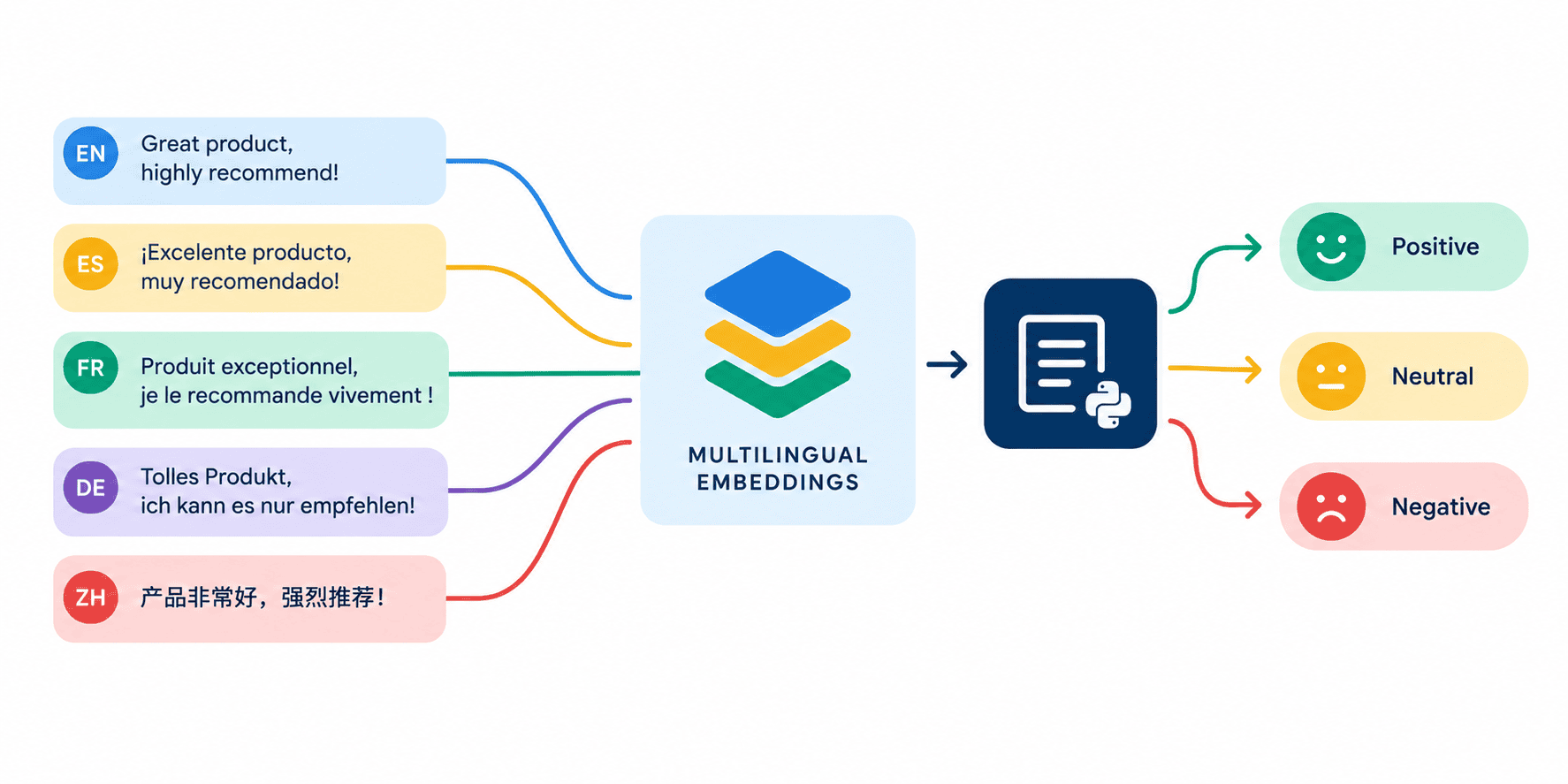
Stop training separate machine learning models for every language your users speak. It is a maintenance nightmare and a computational waste. A new approach using multilingual large language model (LLM) embeddings proves you can unify text classification into a single, lightweight pipeline. By mapping text from different languages into a common vector space, you eliminate the need for language-specific architectures. The barrier isn’t vocabulary anymore; it’s meaning.
The core of this strategy relies on BGE-M3, an open-source embedding model that supports over 100 languages. Instead of paying for proprietary API calls to OpenAI, you can run this locally using Ollama. This setup keeps costs at zero and data within your infrastructure. We configured Scikit-LLM to talk to a local Ollama server, using a dummy key to bypass authentication checks. This allows seamless integration with standard Python data science tools. You get the power of modern LLMs without the cloud bill or latency penalties.
We tested this pipeline on the Amazon Multi-language Reviews dataset, processing 2,000 reviews split evenly between English and Spanish. The workflow uses a GPTVectorizer to generate 1,024-dimensional embeddings, which feed directly into a simple Logistic Regression classifier. The results showed strong performance on extreme ratings, accurately distinguishing 1-star rants from 5-star praise. However, the model struggled with nuanced intermediate scores. Differentiating a 3-star review from a 4-star one proved difficult, likely due to the subtle semantic overlap in moderate feedback.
This performance gap highlights a classic data science trap: overfitting high-dimensional data with small samples. Feeding 1,024 features into a classifier trained on only 1,600 examples is risky. The model memorizes noise rather than learning generalizable patterns. While the concept of language-agnostic classification works, scaling up the dataset is non-negotiable for production use. If you are building global sentiment tools, skip the per-language silos. Just ensure your training volume matches the complexity of your embedding space.