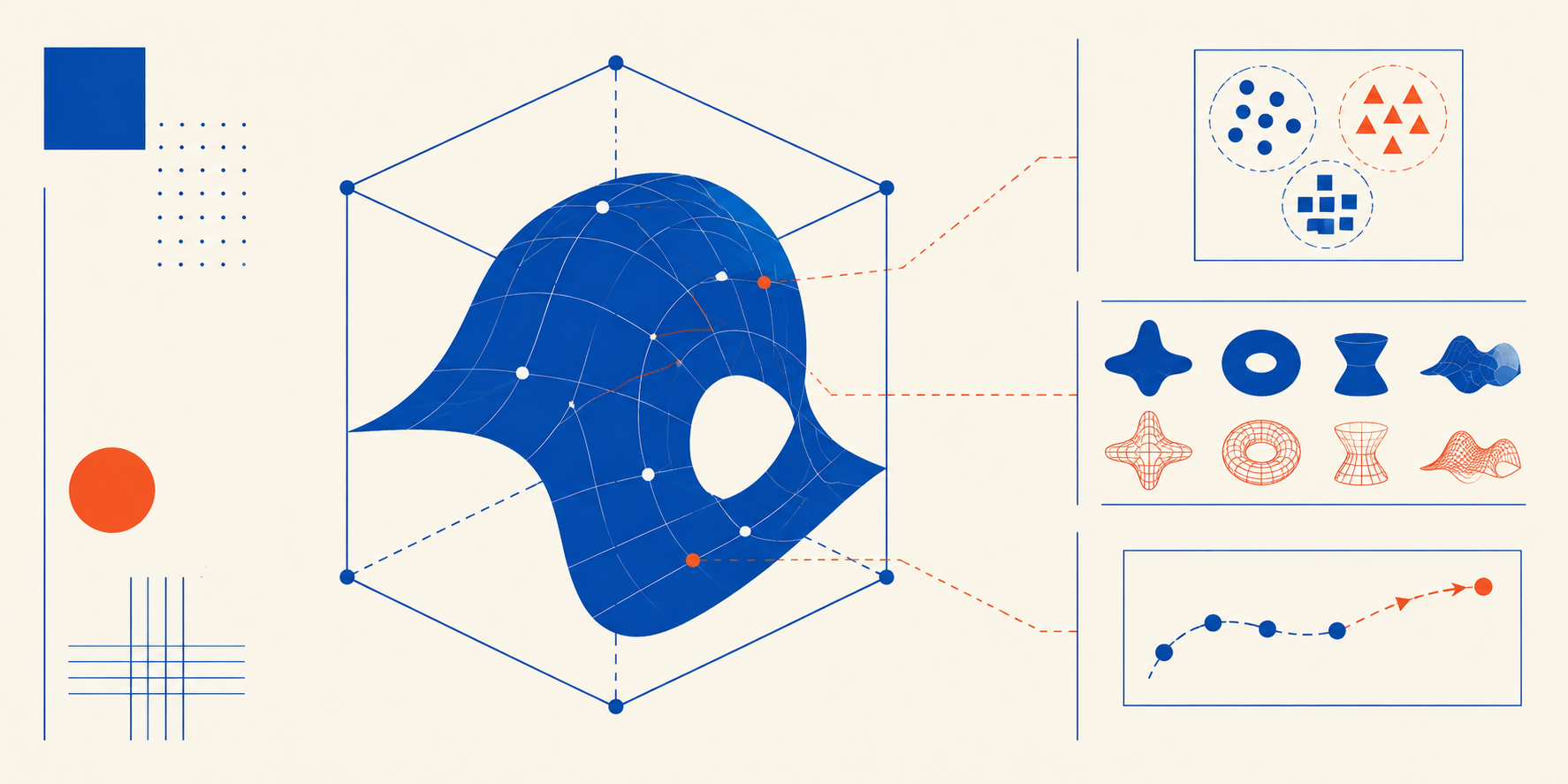
Latent spaces are the compressed numerical maps where machine learning models store what they’ve learned about raw data — and they’re doing more heavy lifting than most practitioners realize. A new breakdown from Inblix contributor Carlos del Álamo distinguishes three distinct roles these hidden representations play: descriptive, generative, and predictive.
The descriptive role is the workhorse of feature extraction. Principal Component Analysis remains the go-to technique for collapsing high-dimensional inputs into something manageable. The article walks through a concrete example: compressing 3D data into a 2D latent space while preserving as much variance as possible. In production, that same logic scales to thinning thousands of features down to a couple hundred. The point isn’t to extract human-friendly features like ‘lighting’ or ‘pose’ — it’s to keep the mathematical relationships intact while discarding redundancy.
Then there’s the generative role, which is where things get interesting. Interpolating between two points in latent space produces entirely new data instances. That’s the mathematical stroll between existing representations, blending feature values to synthesize something that never existed. The article notes this is the core idea behind modern image generators and voice synthesizers, even if the actual architectures — autoencoders, GANs, transformers — are considerably more complex than simple interpolation. Take the concept far enough and you get systems that can alter a person’s eye color in a photo.
Finally, the predictive role powers similarity-based applications. Recommender engines and retrieval-augmented generation pipelines both rely on measuring distances between latent representations to determine what’s relevant. It’s the same mechanism behind facial recognition at airport immigration gates. What’s notable here is how one mathematical concept — compressing data into a structured numerical space — underpins three fundamentally different capabilities. That’s unusual in ML, where techniques typically specialize. Latent spaces are the rare abstraction that generalizes across the entire field.