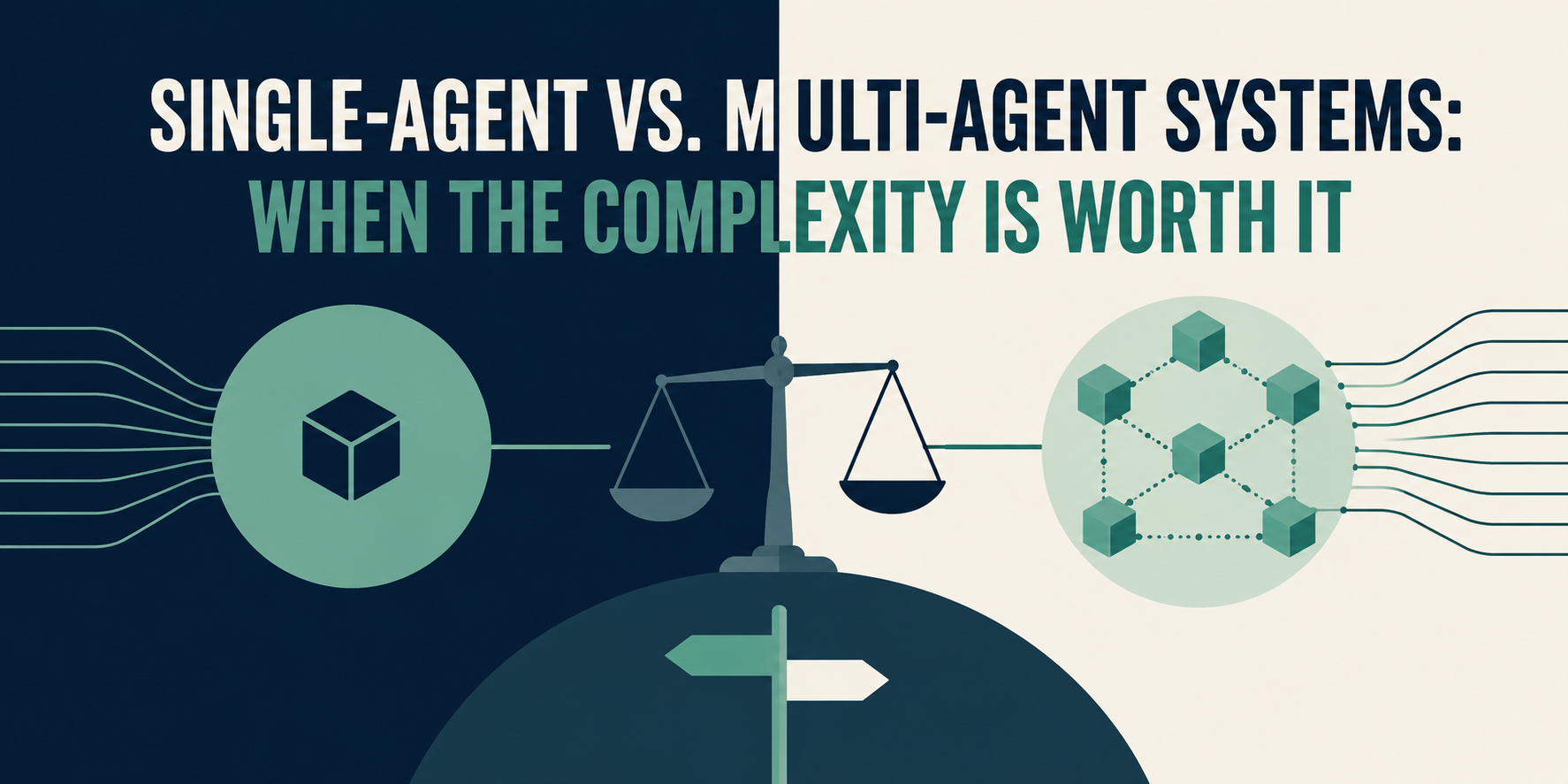
Every AI team eventually hits the same fork in the road: let one agent handle everything, or spin up a crew of specialists? The article cuts through the hype that’s pushed too many teams toward multi-agent architectures before they’ve exhausted simpler options.
A single agent—one model with a defined toolset operating in an act-observe-decide loop—handles far more than most people assume. Customer support triage, research summarization, report drafting, data extraction. A well-built generalist with the right tools covers most organizational needs, and it does so with low latency, predictable costs, and debugging that doesn’t require a forensic investigation. One decision-maker, one conversation history, one trace. When something breaks, you can actually find it.
Multi-agent systems introduce what the author calls a complexity tax, and it compounds fast. Latency stacks as Agent A waits on Agent B before Agent C can move. Token spend multiplies—sometimes dramatically in parallel workflows. Failure modes proliferate: one agent’s bad output cascades downstream, and agents can loop endlessly without carefully defined stopping conditions. Orchestration itself becomes a hard engineering problem. Shared memory, state management, deciding when a sub-task is actually done—none of this is trivial.
The framing is blunt: a single agent is a skilled freelancer. A multi-agent system is an agency—more capable, but saddled with project managers, handoff protocols, and quality checks. The article promises four specific conditions that justify the overhead, though the text available cuts off before enumerating them. That’s a shame, because the build-up makes clear the bar should be high. Teams reaching for multi-agent architectures first are often solving an organizational problem, not a technical one.