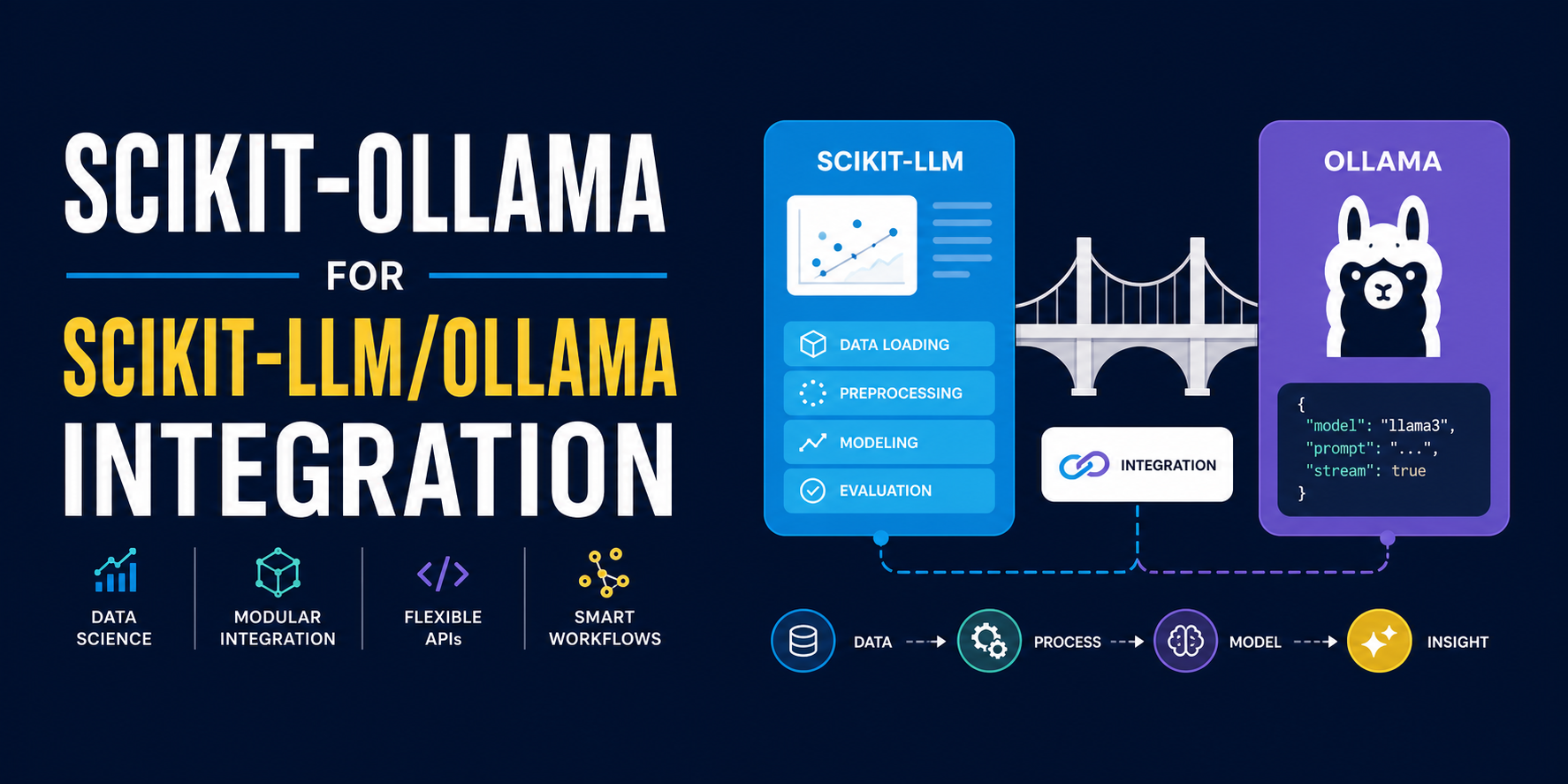
A new library called scikit-ollama is making a compelling case for ditching cloud APIs when you need a language model to classify text. Built largely on the existing scikit-llm project, it wraps the familiar scikit-learn fit/predict pattern around locally running Ollama models. The upshot is straightforward: you get zero-shot classification without a single bit of your data touching a third-party server. No subscription fees, no rate limits, no privacy gymnastics.
The process is surprisingly clean. You pull a model like Llama 3 to your machine, import scikit-ollama’s ZeroShotOllamaClassifier, and instantiate it. The library handles a crucial piece of engineering under the hood — it reformulates your classification task into a constrained text-generation prompt. This forces the general-purpose LLM to output only the candidate labels you’ve defined, mimicking the strict output format of a traditional classifier while still leveraging the model’s language reasoning.
That fit/predict ritual looks familiar to anyone who’s used scikit-learn, but it works differently here. Calling fit() doesn’t update any weights. It simply registers your candidate labels (like “positive” and “negative”) to guide the model through in-context learning. When predict() runs, each movie review gets processed locally, and the output is parsed to ensure it maps cleanly to one of those labels. The first run brings a short initialization delay, but after that, inference stays entirely within your machine’s boundaries.
What’s most interesting here isn’t just cost savings. It’s the architectural shift this pattern enables. Teams that are locked into scikit-learn pipelines for compliance or operational reasons can now inject LLM reasoning into those pipelines without rewriting everything around a cloud vendor’s SDK. The library currently supports Python 3.9 and above, and it leans on Ollama’s model catalog, so swapping in different local models becomes a matter of changing a single argument. I’m watching to see how this handles edge cases like ambiguous reviews or label sets that push the model’s reasoning limits — those stress tests will determine whether this is a practical workhorse or a neat demo.