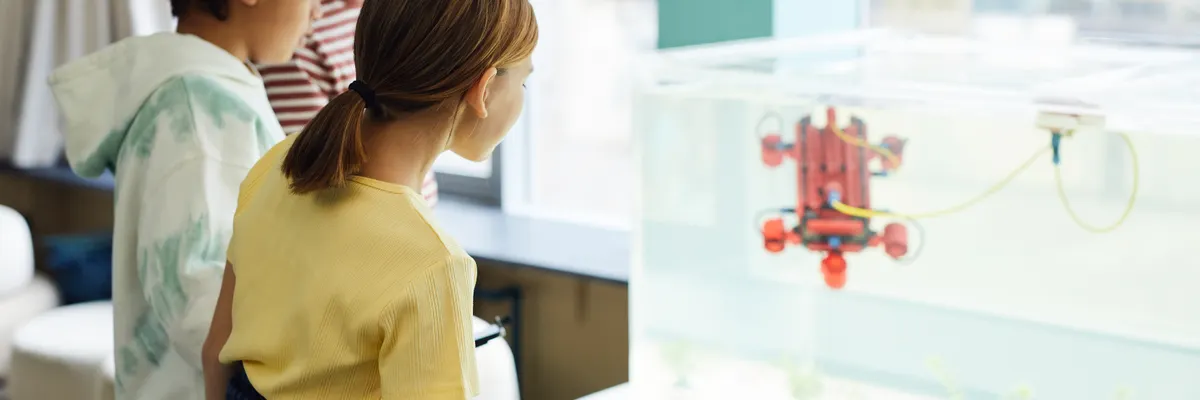
Remotely operated underwater vehicles have a dirty problem: the moment they settle on the seafloor or start digging, they blind themselves. Sediment clouds render onboard cameras useless, and operators are stuck waiting for the water to clear. Amy Phung and Richard Camilli at Woods Hole Oceanographic Institution have built a workaround that pairs sonar with visual data to generate real-time 3D maps, letting vehicles keep working even when visibility drops to zero.
The approach is deliberately two-stage. Sonar does the initial mapping — low resolution, but completely unaffected by murky water. That rough map lets the vehicle navigate safely close to an object of interest. Then cameras take over for the fine detail work. The bottleneck has always been processing speed, so the researchers bolted on an image-matching algorithm originally developed by a French research team that rapidly estimates depth for each pixel in a 2D scene. That combination is what makes the whole pipeline fast enough to run in real time.
Camilli’s analogy cuts to the point: imagine groping through a dark china shop looking for one specific coffee mug without breaking anything. That’s essentially what an underwater robot does near a fragile site. The new system gives it a way to see shapes before it gets close enough to identify them. Applications the researchers point to include scientific exploration, underwater construction and maintenance, and handling unexploded mines — the last of which involves objects you absolutely do not want to bump into blindly.
The mine angle is worth dwelling on. Existing approaches often require either pristine visibility or painstakingly slow, conservative maneuvering. A system that works equally well in cloudy and clear water removes a major operational constraint. Phung, currently a PhD candidate, and Camilli, a WHOI veteran, are building on a long line of sensor-fusion work in marine robotics — but the real-time aspect is what separates this from academic demos. If it holds up in field conditions beyond controlled tests, it could change how subsea inspection and ordnance disposal crews plan their dives.