Large language models have a nasty habit of leaping from question to answer. They predict the next likely token, creating text that looks confident but is often quietly wrong. This flaw becomes critical in multi-step logic or planning. Two techniques now force models to slow down and reason: Chain of Thought and Tree of Thoughts. Both insert intermediate steps between input and output, but their structures differ wildly.
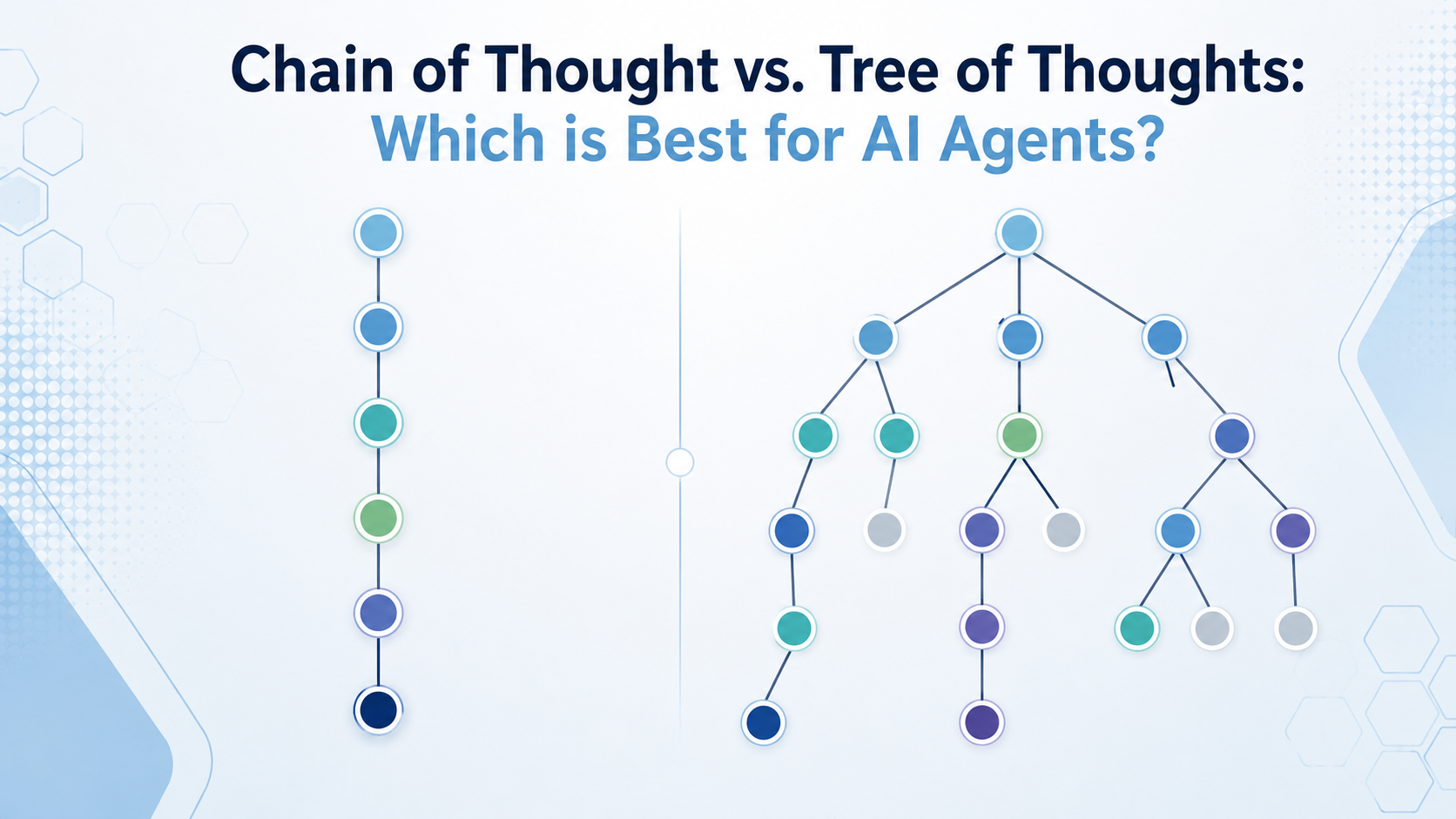
Chain of Thought is the simpler sibling. It asks the model to show its work, moving linearly from problem to solution. You can trigger it with a simple prompt like “Let’s think step by step.” The model writes each calculation in sequence, much like a student solving algebra on paper. This transparency makes it easy to audit. Yet, linearity is its Achilles’ heel. If the model errs at step one, that mistake compounds forward. The system never looks back. It builds every subsequent step on a flawed foundation, leading to coherent but incorrect final answers.
Tree of Thoughts breaks this rigid path. It treats reasoning as a branching structure rather than a single line. At each decision point, the model generates multiple possible next steps. It evaluates how promising each branch looks before committing. If a path leads to a dead end, the system backtracks and tries a different route. Think of a chess player calculating several moves ahead, not just the most obvious one. This non-linear approach allows for error correction and exploration of ambiguous problems where multiple valid approaches exist.
For AI agents, choosing between these frameworks isn’t cosmetic. It defines capability. Chain of Thought suffices for standard math or summarization tasks where the path is clear. But when stakes are high or ambiguity reigns, the single-path constraint becomes a liability. Tree of Thoughts handles complexity by allowing evaluation and retreat. As agents tackle harder problems, the industry must move beyond simple linear prompts. We need systems that can admit uncertainty and change course, rather than confidently marching off a cliff.