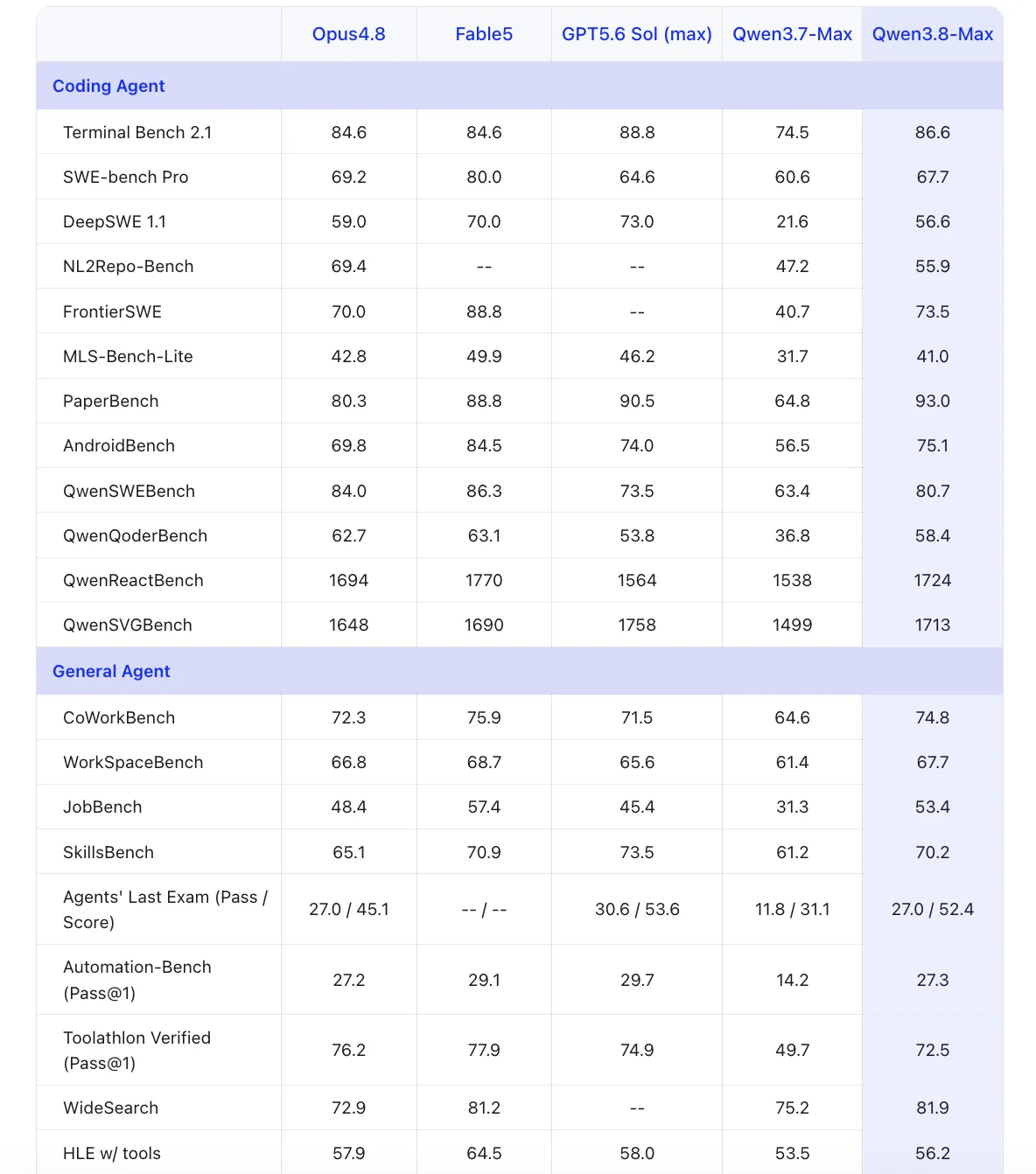
Z.ai dropped GLM-5.3-Flash this week, and the numbers are aggressive: a 320B-parameter mixture-of-experts model with only 18B active per token, a million-token context window, and native image and video input. It’s MIT-licensed, which means the weights are sitting on Hugging Face for anyone to grab. The lab claims it lands within half a point of Claude Opus 4.8 on their internal coding benchmark while costing roughly a tenth of what GLM-5.2 charged. That’s the kind of pricing shift that forces procurement teams to redo their spreadsheets.
What’s interesting is how it spent its first week. The model ran anonymously as “Ox Alpha” on OpenCode and OpenRouter, served entirely on domestically produced Chinese AI chips. Nobody knew what it was — just a mysterious high-performing model topping leaderboards. Z.ai says they used a custom SGLang-based engine that disaggregates encoding, prefill, and decoding, reporting a 3× end-to-end serving improvement across tens of thousands of accelerators. The serving infrastructure story matters as much as the weights here, because it signals real deployment capability, not just a research artifact.
The architecture has three tricks worth paying attention to. Hybrid attention combines KDA linear-attention layers with NoPE sparse MLA layers — linear attention handles local dependency while sparse attention retrieves globally relevant context. That’s a first for the GLM series. IndexPool compresses groups of indexer key vectors through weighted pooling, which Z.ai says delivers roughly 3× less attention compute and a 4.4× smaller KV cache versus the previous generation. And mHC, or Manifold-Constrained Hyper-Connections, lets the model roughly halve both activated parameters and layer count at similar total parameter count compared to GLM-4.5. The result: 84.3 on Terminal-Bench 2.1 and 63.4 on DeepSWE v1.1.
Self-hosting is not for everyone. The default FP8 checkpoint runs about 306 GiB of weights before you even factor in KV cache, and current vLLM support requires NVIDIA Hopper or newer. That puts it in reach of mid-size and large orgs with at least an 8-GPU node, plus AI-native startups renting capacity. Everyone else consumes it as an API at $0.15 per million input tokens and $0.50 per million output tokens — with a discounted tier hitting $0.045 per task on the Artificial Analysis Intelligence Index. Independent testing puts it at 57 on the intelligence index with 48.7 output tokens per second. Slow and verbose, as they put it, but strong intelligence-per-dollar. Vision is the weak flank, trailing Gemini 3.7 Flash on BabyVision and MVbench, so don’t expect it to replace your multimodal workhorse yet. Still, for repo-scale coding agents, million-token log analysis, and UI regression checking, this is a serious contender at a price point that resets expectations.