A cheap drone that already killed $19 million Russian helicopters is getting a brain. By the thousands.
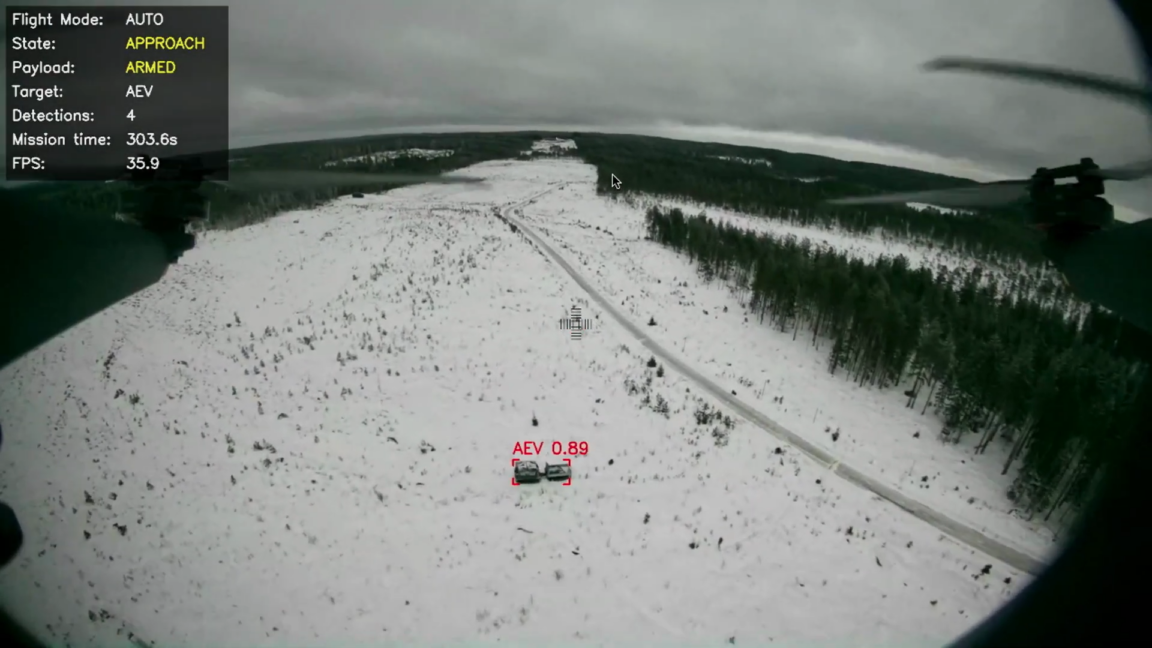
Starting in mid-July, Ukrainian forces began receiving Shrike FPV drones upgraded with Auterion’s Skynode S strike kit — an American-made AI system that lets the $400 quadcopter track and hit moving targets entirely on its own. Lorenz Meier, Auterion’s CEO, described the workflow: a human pilot flies the drone near the target area, designates something up to half a mile out, then flips a switch. From that point, it’s fire-and-forget. The drone’s onboard camera feeds visual data to the software, which handles terminal guidance with no GPS, no radio link, and no human hand on the stick.
That last part is what changes the equation. On a battlefield saturated with electronic warfare, radio signals get jammed constantly. Buildings and terrain block them. A drone that loses its connection usually becomes a paperweight. But Meier told Ars Technica that the Skynode S keeps homing even after the link goes dead. The operator can still abort or redirect as long as the signal holds — but if it doesn’t, the drone finishes the job anyway. Auterion and Ukrainian manufacturer SkyFall plan to push out 50,000 of these upgraded Shrikes in the coming months.
The track record behind those numbers is concrete. Shrike drones have already knocked out armored tanks, artillery pieces, electronic warfare systems, and rocket launchers since Russia’s full-scale invasion. They’ve also taken down two Russian Mi-28 attack helicopters — each valued at roughly $19 million, per the Kyiv Independent. When a disposable drone costing less than a used iPhone can erase an attack helicopter, the economics of air defense start to look fundamentally different.
What’s worth watching is how this shifts the skill floor for drone operators. Terminal guidance against a moving target is hard. It takes hours of simulator time and a steady hand. Offloading that last phase to an AI — one that doesn’t panic, doesn’t flinch, and doesn’t need a signal — could turn part-time pilots into precision strike assets faster than any training program. The flip side is obvious too: once the switch is flipped, the human is out of the loop. That’s a line that gets blurrier with every new delivery.