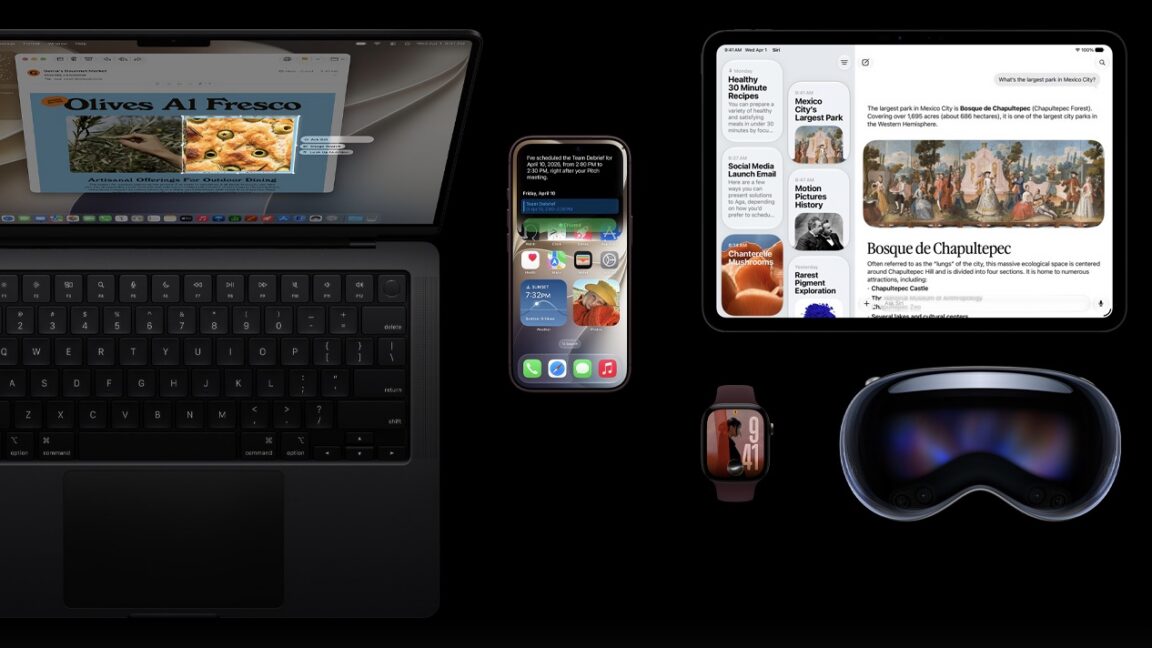
Apple has officially rolled out its 2026 operating system updates, bringing iOS 27, macOS 27 Golden Gate, watchOS 27, visionOS 27, and tvOS 27 to devices worldwide. The headline act is undeniably Siri AI, a context-aware overhaul that finally moves beyond simple command execution. This new assistant leverages large language models to understand natural language requests, search through personal history like old emails, and even explain what is currently on your screen. It also gains the ability to interact directly with third-party apps, provided developers have enabled support. Notably, tvOS remains the outlier here, missing out on the Siri AI upgrade entirely.
Under the hood, Apple is relying on its proprietary AFM 3 model family to power these features. The on-device experience is driven by AFM 3 Core, a 3-billion-parameter model, and the more capable AFM 3 Core Advanced. This latter model boasts 20 billion parameters but uses a sparse architecture, activating only 1 to 4 billion parameters at a time depending on the complexity of the request. For heavier lifting, Apple routes tasks to cloud-based variants like AFM 3 Cloud and AFM3 Cloud Pro. This hybrid approach aims to balance privacy and speed with raw computational power, a tightrope walk Apple has been navigating aggressively since introducing Apple Intelligence.
Users will also notice a dedicated Siri app, which bears a striking resemblance to standalone chatbots like ChatGPT or Claude. Beyond conversational AI, the update introduces generative tools for creating Shortcut automations and Safari extensions via simple prompts, alongside enhanced photo editing capabilities. On the design front, Apple is addressing long-standing feedback regarding the “Liquid Glass” aesthetic. Both iOS and macOS now include a slider allowing users to adjust interface transparency, offering a level of customization that was previously absent. While not a radical redesign, this polish pass suggests Apple is listening to user fatigue with overly opaque UI elements.
The shift toward a dedicated Siri app signals a broader change in how we interact with our devices, moving from discrete commands to continuous, context-aware assistance. However, the real test will be developer adoption for direct app interaction. Without broad support, Siri AI risks becoming a sophisticated walled garden rather than a truly integrated helper. The sparse activation strategy for the 20-billion-parameter model is a clever engineering feat, but whether it delivers consistent latency improvements remains to be seen in daily use.