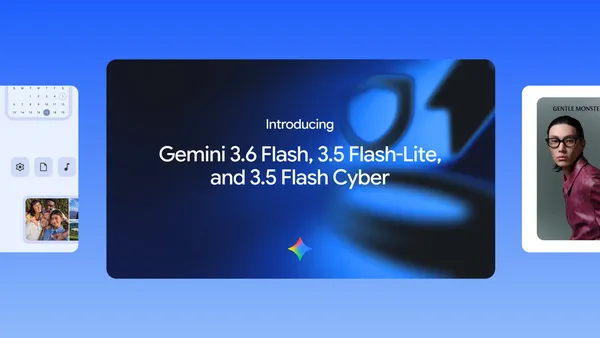
Google dropped a trio of new Gemini Flash models today, and the through-line is clear: the company is optimizing aggressively for the economics of agentic work, not just raw benchmark scores. The headliner is Gemini 3.6 Flash, a direct upgrade to the workhorse 3.5 Flash that Google says uses up to 65% fewer output tokens on the DeepSWE coding benchmark. That verbosity cut, combined with a trimmed output price of $7.50 per million tokens (down from $9.00), meaningfully lowers the bill for high-volume developers. Quality didn’t take a backseat—on DeepSWE, 3.6 Flash hits 49% versus the previous 37%, and MLE Bench scores jump from 49.7% to 63.9%. Early customers like Hebbia and Harvey are already citing gains in document parsing and report drafting.
Then there’s Gemini 3.5 Flash-Lite, a speed demon clocking 350 output tokens per second. Priced at a minuscule $0.30 per million input tokens, it’s built for low-latency search and document processing slogs. What’s surprising is it doesn’t just beat the older 3.1 Flash-Lite—it outmuscles the original 3.5 Flash on some evals, scoring 54.2% on SWE-Bench Pro versus 49.6%. Google is exposing configurable thinking levels here, letting developers trade smarts for speed on a per-task basis. It’s a pragmatic nod to the fact that not every subagent needs a PhD.
The most specialized release is Gemini 3.5 Flash Cyber, fine-tuned for automated vulnerability discovery and packaged inside a new tool called CodeMender. The design philosophy is a bet against giant, monolithic reasoning models for security work. Instead of one expensive call, CodeMender launches up to five parallel Flash Cyber agents to explore a massive execution search space, merging their findings into a single report. The internal numbers are genuinely eye-catching: on Google’s Big Sleep evaluation, it trounced both mainline 3.5 and 3.6 Flash, and on the V8 JavaScript engine it found 55 unique confirmed bugs at a fixed invocation count—19 more than Claude Opus 4.6.
Community reaction was split right down the middle. Builders cheered the price-to-performance ratio, but frustration boiled over on Hacker News about Google’s ability to provision the promised capacity, with some users recounting painful hands-on coding sessions. The gated release of Flash Cyber also reignited the dual-use debate: who should have access to automated exploit-finding tools that can surface remote-code-execution flaws in public APIs within two hours? It’s a valid question Google will have to answer as these specialized agents grow more capable. Gemini 3.6 Flash and 3.5 Flash-Lite are available now via Google AI Studio and Android Studio, with 3.6 Flash also rolling out in Google Antigravity and GitHub.