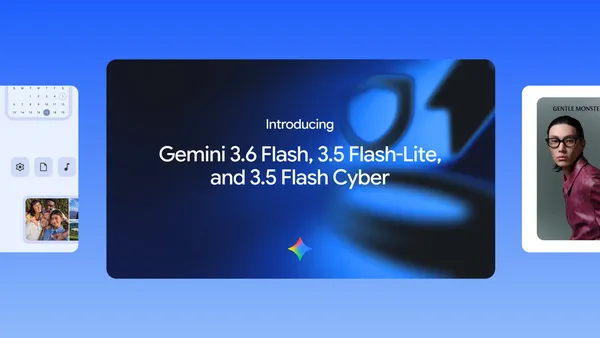
Google’s July AI blitz wasn’t about flashy demos — it was a practical, developer-focused push to make agentic AI cheaper, faster, and physically capable. The headliner is the new Gemini 3.6 Flash model, built specifically for the “sweet spot of efficiency and quality” that production AI agents demand. It’s joined by 3.5 Flash-Lite and 3.5 Flash Cyber, signaling a clear strategy: Google is carving out model tiers for specific operational needs, not just chasing benchmark scores. Lower token costs and reduced latency are the unsexy but essential levers that determine whether an AI agent scales or bankrupts its operator.
On the hardware side, the launch of Gemini Robotics ER 2 marks a significant leap. Described as an “embodied reasoning” model, ER 2 is designed to bridge the infuriating gap between a chatbot’s fluent text and a robot’s clumsy grasp of the physical world. It promises natural conversation alongside the spatial understanding to execute multi-step tasks. This isn’t a research paper; it’s a model for developers “crafting genuinely helpful machines,” a signal that Google DeepMind sees the path to useful home robots running through language models that can reason about objects and environments.
The updates also reveal a deepening integration into Google’s ecosystem that goes beyond simple chat. The rebranded Gemini Notebook (formerly NotebookLM) now threads through the Gemini app and Search, while Gemini Spark gets the creepy-but-useful ability to use your logins to autonomously research flights or schedule apartment viewings. It’s a vision of AI that doesn’t just answer questions but performs web errands on your behalf, a step that requires a level of trust that will make many users pause. Meanwhile, the Alliance for America’s Skilled Trades, backed by Google, BlackRock, Carhartt, and Ford, is a reminder that the company is also thinking about AI’s downstream effects on the labor market, aiming to build a pipeline for jobs that a robot can’t easily take — yet.


