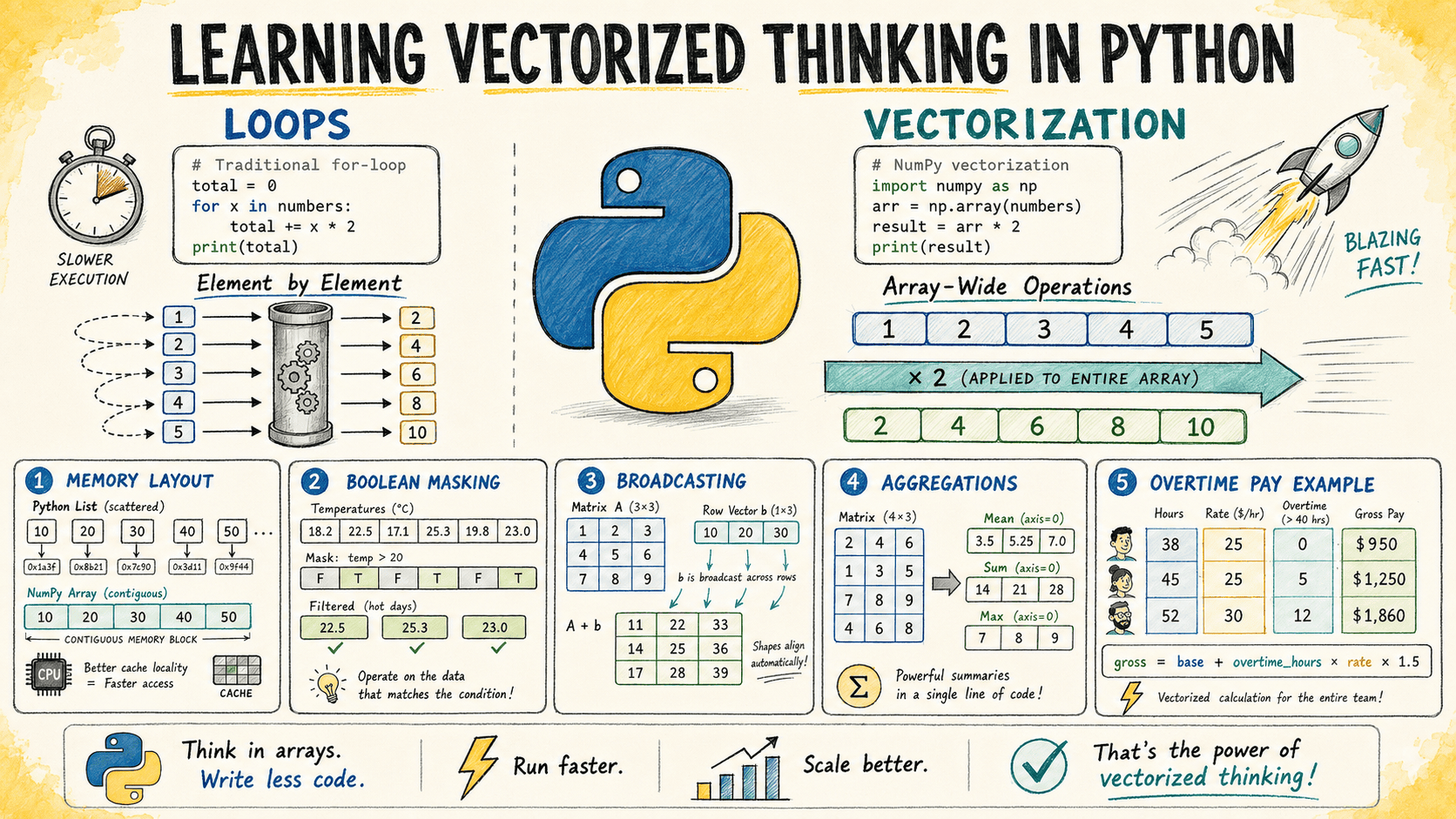
Every Python developer hits the same wall eventually. The loop that worked fine on a thousand rows grinds to a halt on a million. The culprit isn’t your logic—it’s Python’s dynamic typing. Every x * 2 inside a loop forces the interpreter to check types, look up methods, execute, and allocate a new object. Repeated millions of times, that overhead dominates.
NumPy sidesteps the problem entirely. Arrays store raw numbers in contiguous memory, like C. When you write prices * 1.12, the entire operation gets handed to a compiled C routine. No per-element Python overhead. The article’s example applies a 12% tax to product prices: the loop version iterates and appends, while the vectorized version is a single expression. Output is identical. Performance is not.
The real lesson is a mental shift, not a syntax swap. You stop thinking “for each price, do this calculation” and start thinking “apply this transformation to the array.” The array becomes the unit of computation. That shift unlocks three patterns: element-wise operations replace simple loops, boolean masking replaces conditional checks (generate a True/False array, then use it to filter or modify), and np.where() handles conditional assignment compactly.
Broadcasting handles the trickier cases where arrays have different shapes. The article’s example normalizes click-through rates across five campaigns and three channels by dividing each column by its maximum—a task that would require nested loops in pure Python. Broadcasting applies the operation across dimensions without creating redundant copies. For developers working with numeric data at any real volume, these patterns aren’t optional optimizations. They’re the difference between code that finishes and code you kill after lunch.