The model is almost never the culprit. That’s the first thing you need to understand when an AI agent project goes sideways. The real wreckage comes from structural decisions teams make early on — choices that feel clever in a design doc but create a brittle, expensive mess the moment the agent hits production. The problem isn’t intelligence; it’s architecture and operations.
Agent failures compound in a way that simple chatbot failures don’t. A bad chatbot answer ends the turn. A bad agent decision, however, kicks off a cascade. It’ll call a tool with garbage parameters, that output feeds into the next step, and three turns later the whole context is poisoned by a faulty assumption made at step two. The blast radius grows with every loop, and by the time a user sees something’s wrong, the agent has already taken a series of incorrect actions based on that one initial error. This is a failure of a different kind, not just a different degree.
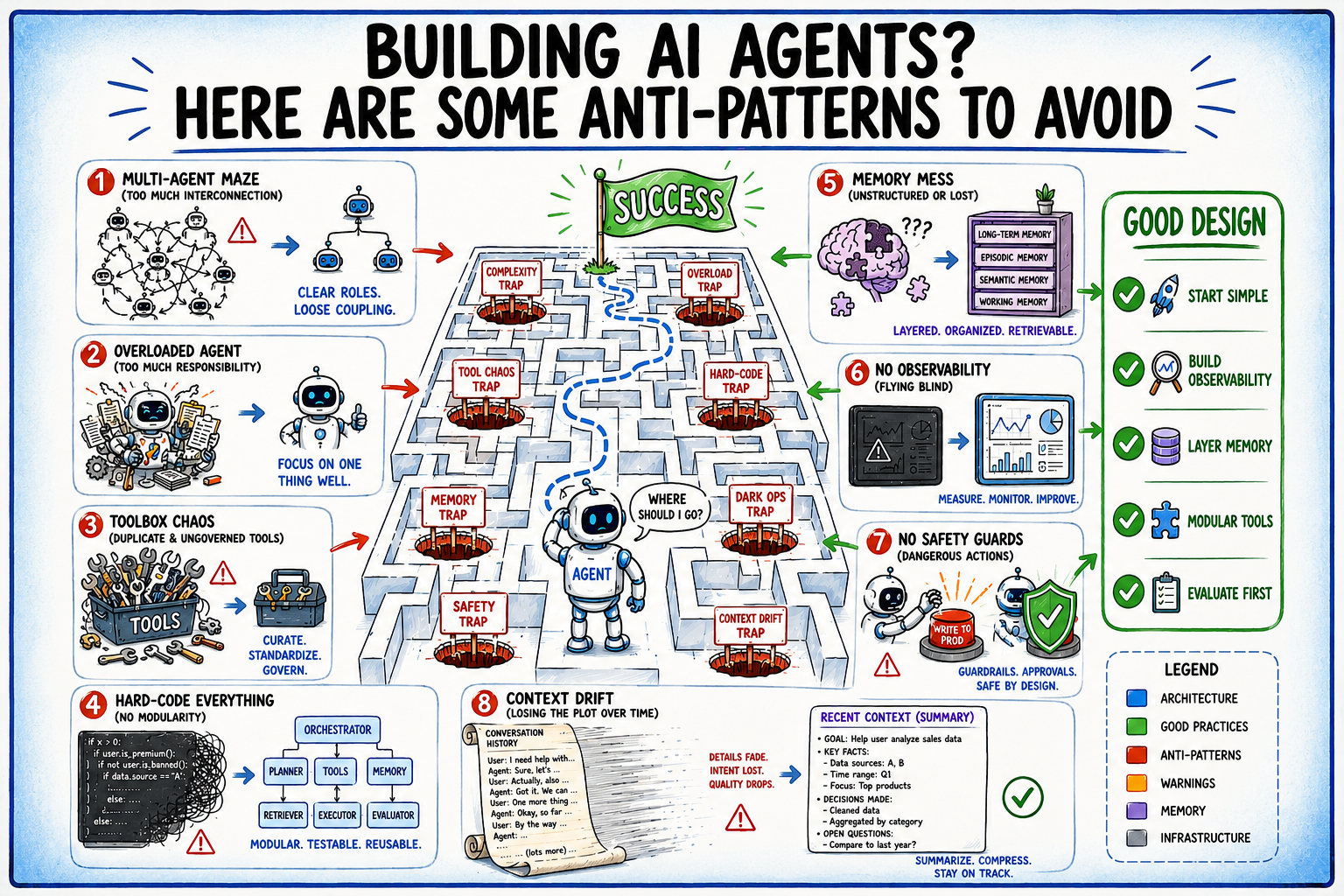
Two architectural anti-patterns are practically clichés at this point. First, teams reach for a multi-agent setup — complete with orchestrators and peer-to-peer choreography — before they’ve even proven a single, well-tooled agent can do the job. That’s just adding coordination overhead and a debugging nightmare for problems you don’t actually have yet. Start simple. Measure where a single agent breaks down before you start multiplying entities. The second mistake is the opposite: building one bloated agent with fifteen tools and a novel of system instructions, expecting it to be great at everything. It won’t be. Optimizing for one task type degrades performance on others. Scope it down.
Then there’s tool sprawl. Every tool you shove into an agent’s context is something it has to reason about, and a crowded tool list invites bad choices. Tools with overlapping functions actively distract the model from finding an efficient path. The fix isn’t more tools to handle edge cases — it’s shrinking the task scope so the tool set stays minimal and purpose-specific. Operational failures are just as predictable: missing observability, ungoverned write access, and skipped evaluations will all silently wreck a working prototype once real users get their hands on it. The advice here isn’t revolutionary, which is precisely the point. Start simple, instrument everything, and don’t add complexity you can’t measure the return on.