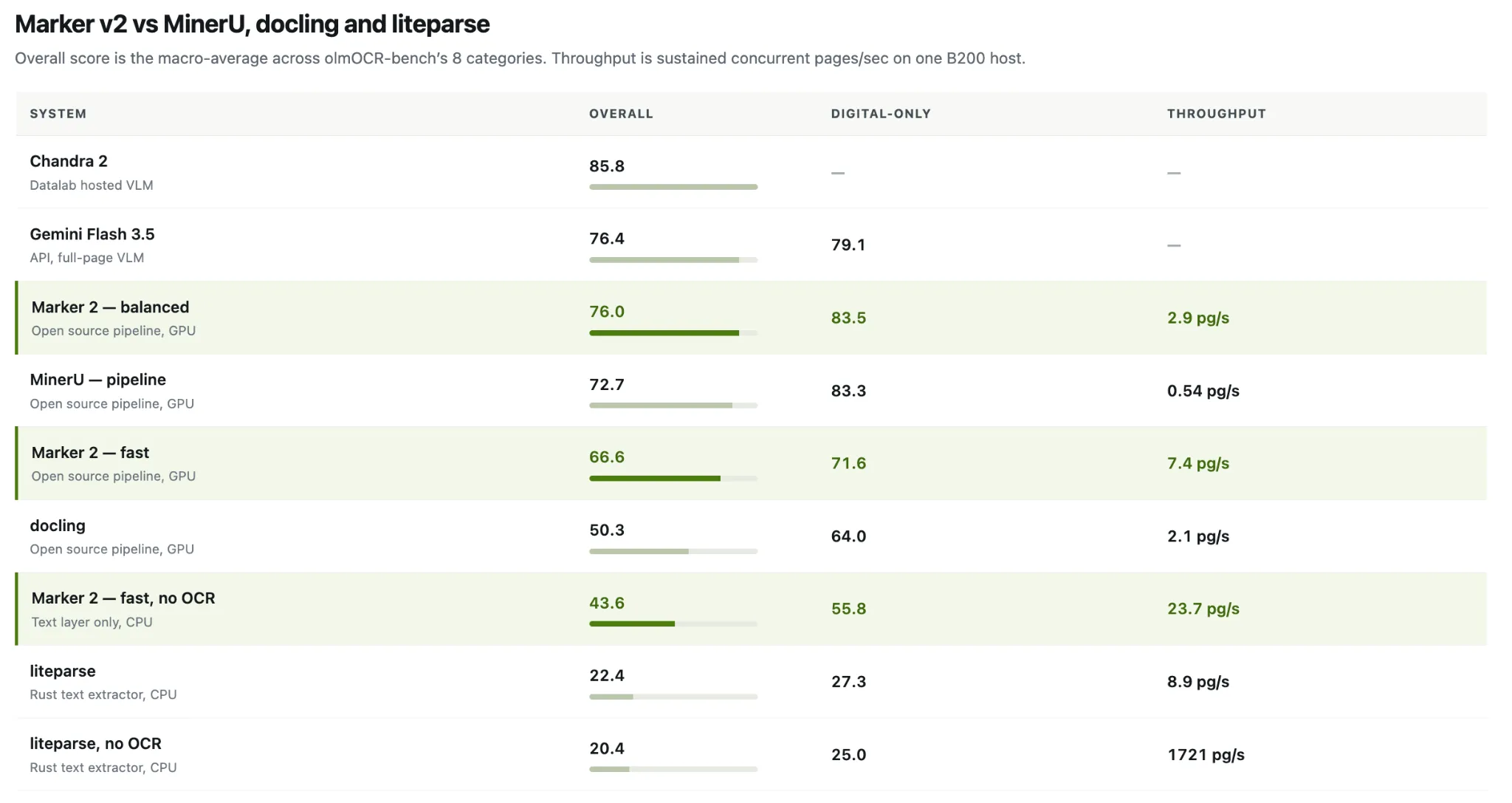
Datalab dropped Marker 2 this week, and the numbers are worth paying attention to. It is a ground-up rewrite of their open-source document converter, and on Allen AI’s third-party olmOCR-bench it scores 76.0% overall while churning through 2.9 pages per second on a single B200. That is over five times the throughput of MinerU’s pipeline backend, which manages 72.7% at a comparatively glacial 0.54 pages per second.
There is a real architectural shift behind that speed. The team broke the pipeline into three paths — balanced, fast, and a pure CPU mode with no VLM calls at all. Balanced mode throws Surya VLM at the whole page whenever embedded text looks suspect. Fast mode uses a lightweight 20M-param layout detector and only calls the VLM surgically, hitting 7.4 pages per second at 66.6%. The third mode runs layout detection entirely on CPU and still pulls 43.6% without touching a GPU. That CPU-only result matters more than the accuracy suggests because it means you can process documents on a laptop without standing up an inference server.
The concurrency model is the clever bit. Multiple thin CPU workers share one Surya inference server, with the parent process budgeting VLM concurrency across them. The result: nearly 10× the throughput of single-stream processing on identical hardware. Datalab published the full harness in the Marker repo with runners for MinerU, Docling, and LiteParse, so the comparisons are reproducible — though every number comes from their own B200 runs, not independent audits.
Docling gets left behind on raw accuracy at 50.3%, though it has governance advantages as an IBM Research project hosted under the Linux Foundation. LiteParse is the wildcard: 1,721 pages per second with OCR off, but only 22.4% accuracy. Teams running their own documents through this harness should expect different results on different corpora. That is not hedging — it is how benchmarks work. The question is whether Marker’s balanced mode can hold that 76% on messy, real-world PDFs that are not in Ai2’s 1,403-document test set.